The number everyone gets wrong
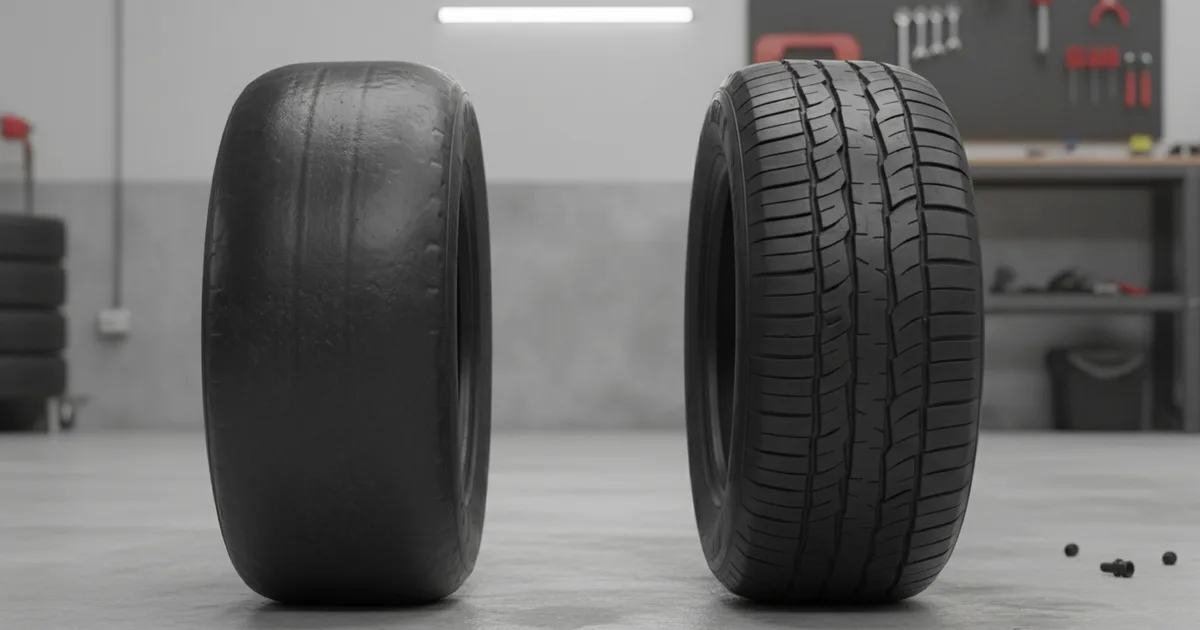
Ask most drivers what makes a car fast and they will say horsepower. More power, more speed, simple. It is not simple, and it is not true once tyres are worn. A car putting out 500 hp on poor tyres can be slower, in a straight line and everywhere else, than a car with half that power on excellent tyres. That is not a marketing line. It is how racing teams have built cars for decades.
The tyre is the car
Professional racing teams have a saying that sums it up: the tyre is the car. Not the engine, not the suspension, the tyre. Every bit of power an engine produces has to travel through four small contact patches to actually move the car. Every bit of braking force has to go through the same four patches to slow it down again. If those contact patches cannot grip, the power and the braking never reach the road. They just spin, slide, or get thrown away as wasted heat and noise.
That is why a race engineer will spend more time talking about tyre temperatures and wear than about the engine map. The engine is a known quantity. It makes what it makes. The tyre is the variable that decides whether any of that output is usable. A driver with a strong engine and a weak tyre is driving with one hand tied behind their back, and no amount of extra power fixes that.
Grip is not optional, it is the whole job
Grip does three jobs at once: it gets power down under acceleration, it gets braking force down under deceleration, and it holds the car's line through a corner. A tyre that has lost tread depth, gone hard with age, or is simply the wrong tyre for the car does all three jobs worse. The engine does not know or care. It sends the same power either way. What changes is how much of that power turns into actual forward motion versus how much turns into wheelspin, wander, or a longer stopping distance.
This is not just a track phenomenon. The same physics apply to a daily driver doing the school run or a tradesman's van loaded with tools. The engine has a job to do, but the tyre decides how well that job gets done. A car with tired tyres and a strong engine will still struggle to get away cleanly from a wet junction or stop in time for a car pulling out ahead. The horsepower figure on the spec sheet is not what is happening at the road surface. The tyre is.
Why this matters more on roads like ours
On the roads around Tayside, Perthshire and Fife, that gap between what an engine can produce and what a tyre can put down gets tested constantly. Wet single-track roads, exposed stretches with standing water, sharp braking for tractors or livestock pulling out of a farm gate: none of it cares what your engine is capable of on paper. It cares what your tyres can do in that exact moment, on that exact surface. A car with plenty of power and thin or ageing tyres is not driving with a safety margin, it is driving on borrowed grip.
What this means for tyre choice and upkeep
The practical takeaway is not to obsess over horsepower figures and then treat tyres as an afterthought. Tread depth, tyre age, and correct tyre choice for the car and the conditions all directly affect how much of that engine's output actually reaches the road. A worn tyre does not just wear out gradually and predictably, it loses grip in the situations that matter most: heavy braking, standing water, a cold morning start. Those are exactly the moments where the difference between a good tyre and a poor one shows up.
Checking tyres regularly and replacing them before they become the weak link is a cheaper and more effective performance upgrade than almost anything else you could do to a car. It is also one of the easiest things to put off, because a tyre rarely announces that it has quietly become the limiting factor in how your car handles, brakes, or gets away from a junction. If you are not sure whether your current tyres are still doing their job properly or need swapping out, our mobile fitting service comes to wherever the car is parked and gets it sorted without you needing to find time to sit in a waiting room.
The bottom line
Horsepower is what an engine can produce. Grip is what actually gets used. A car is only ever as capable as its worst tyre, no matter what the badge on the back says or what the spec sheet claims. Racing teams learned that lesson under the harshest possible scrutiny, with lap times and championships on the line. It applies just as much to an ordinary car doing ordinary miles: the tyre is the car.