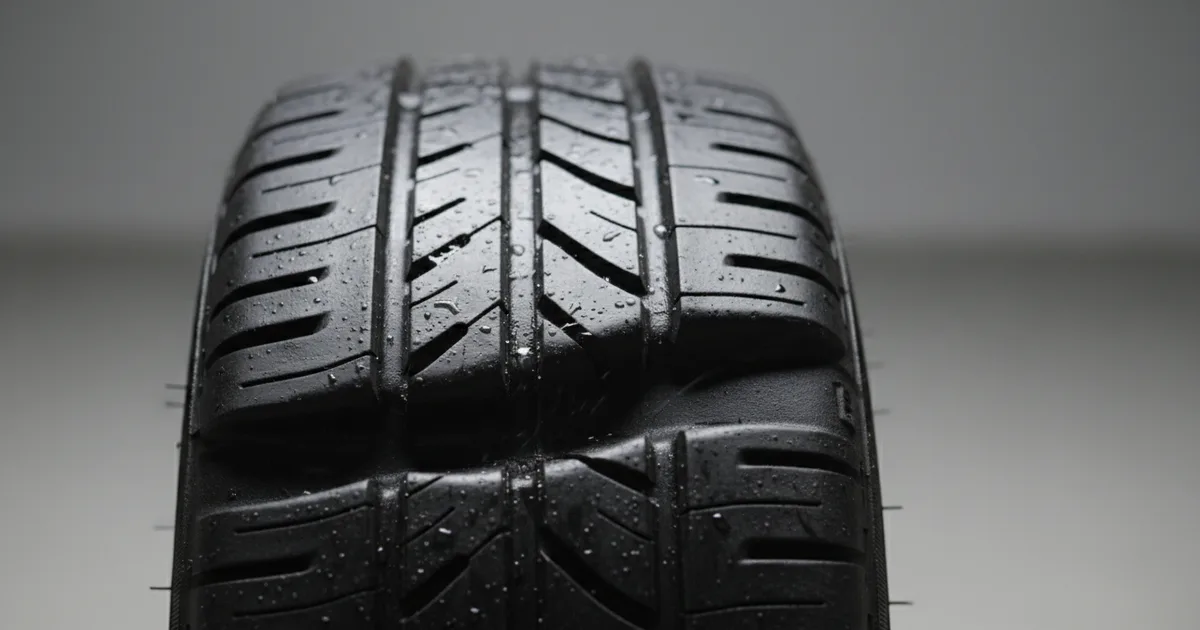
Press a tyre and watch what happens
Push your thumb into a tyre's tread block and let go. It doesn't snap back to shape the instant you release it. There's a lag, a fraction of a second where the rubber is still catching up with itself. That lag has a name: viscoelasticity. It means rubber behaves partly like an elastic solid, which wants to return to its original shape, and partly like a viscous fluid, which resists changing shape quickly and dissipates energy as it deforms. Every tyre on every van and car we fit runs on this exact quirk of material science.
It sounds like a footnote for a chemistry textbook, but it isn't. Tyre engineers don't just tolerate viscoelasticity, they use it on purpose. The way a compound stores and releases energy as it flexes is one of the main levers they pull to tune how a tyre sounds, how it rides, how much grip it gives you in the wet, and how long it lasts before you're back on the phone to us. Get that balance wrong and you end up with a tyre that's brilliant in one area and hopeless in another.
One material, four jobs, constant trade-offs
Here's the problem tyre designers are actually solving. A tyre that returns energy quickly and efficiently after being flexed rolls with less resistance, which is good for fuel economy and can make a tyre feel sharper and more responsive. But a compound tuned that way often struggles to grip in the wet, because grip depends on the rubber deforming into the microscopic texture of the road surface and holding that shape for a moment rather than springing away from it. Slow that spring-back down and you get more grip, but you also get more heat, more rolling resistance, and often more noise as the tread blocks take longer to settle after each contact with the road.
This is why tyre design is far more complicated than it looks from the outside. It isn't a case of picking "hard rubber for wear" or "soft rubber for grip" and calling it done. It's a continuous balancing act between noise, comfort, grip and wear, all controlled through how the same lump of rubber behaves as it deforms and recovers, thousands of times a minute, at every corner of the car. Change the compound to quieten road noise and you might lose some wet grip. Firm it up for lower wear and the ride gets harsher. Every tyre on the market is a specific, deliberate compromise between those four things, not an accident.
Why this matters more once a tyre's had some life
Viscoelastic behaviour isn't fixed for the life of the tyre either. As rubber ages and as tread depth reduces, the way it flexes and recovers changes, and so does the balance the engineers originally tuned in. A tyre that felt quiet and planted when new can start to feel vague or noisy as it wears, not because anything's broken, but because the compound and the tread pattern were designed to work together at a certain depth and shape. That's part of why we'd rather replace a tyre before it's marginal than wait until it's actually failed. On the kind of roads we cover around Tayside, Perthshire and Fife, wet single-carriageway A-roads, harsh braking into roundabouts, potholed back lanes after a hard winter, that grip and recovery margin gets used constantly, and it's not something you want to be finding out has quietly eroded.
None of this is something a driver needs to think about day to day. You don't need to know the difference between elastic and viscous behaviour to know whether your tyres feel right. But it's worth understanding that when a tyre feels planted in the wet, or rides smoothly over a rough surface, or stays quiet at motorway speed, none of that is luck. It's the result of engineers working with, rather than against, a material that genuinely has a kind of memory, one that takes a moment to let go of the shape it was just pushed into.
If you're not sure whether your current tyres still match how and where you actually drive, or you just want them checked and fitted properly without taking the car off the road, our mobile fitting service comes to you, wherever you are in Tayside, Perthshire or Fife. We'll fit tyres that suit your driving, not just whatever's cheapest on the shelf.