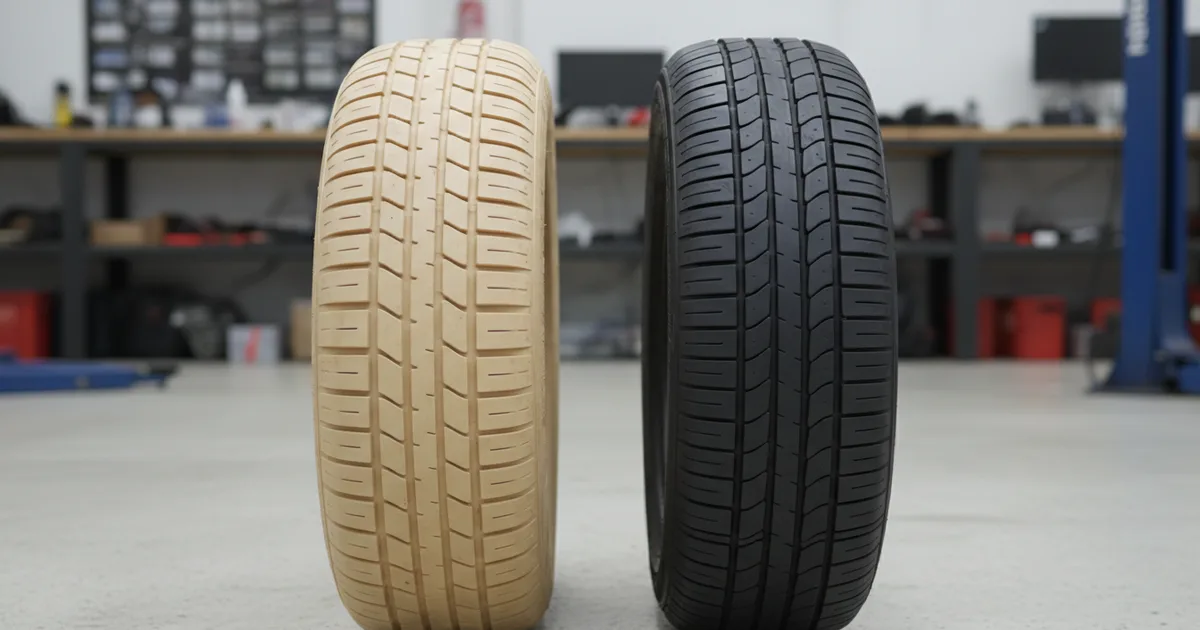
Tyres were not always black
If you picture the earliest rubber tyres, forget the black rubber you see on the road today. Natural rubber on its own is pale, closer to grey or tan, and that was the colour of tyres before manufacturers changed the compound. Black is not the natural state of rubber, it is the result of an additive that changed the tyre industry for good.
The problem with plain rubber
Rubber on its own has a real weakness: it does not last. Early tyres made from untreated rubber wore out very quickly. The material broke down under load, cracked with age and exposure, and simply could not stand up to sustained use on real roads. A tyre that degrades that fast is not just an inconvenience, it is a safety problem, and it meant early motorists were replacing tyres far more often than drivers do now.
Carbon black changes everything
The fix came from an additive called carbon black. Mixed into the rubber compound, it dramatically increased how long a tyre could last on the road. It is not a cosmetic change, the colour shift is a side effect of what carbon black actually does to the rubber itself.
Carbon black improved the rubber's resistance to UV light, which matters because sunlight breaks down untreated rubber over time. It reduced cracking, one of the main ways older tyres failed. And it improved how the tyre managed heat, which is important because a tyre generates and absorbs a lot of heat through friction with the road, through braking, and through the flexing of the sidewall as the tyre rotates. Manage that heat badly and the compound degrades faster and the risk of failure goes up. Manage it well and the tyre holds its structure and grip for far longer.
Put those three things together, better UV resistance, less cracking, better heat management, and you get a tyre that simply lasts. That is the whole reason carbon black became standard. It was not about how a tyre looked, it was about how long it survived.
Why this still matters on Tayside, Perthshire and Fife roads
None of this is just history for its own sake. The same properties that made carbon black worth adding in the first place are the ones your tyres rely on every day on local roads. A Scottish year swings from summer sun to hard winter frost, and tyres sit outdoors in all of it, parked on driveways and streets, exposed to UV and to temperature swings that stress the rubber compound. Cracking from age and weather exposure is still one of the things we check for on every callout, particularly on vehicles that do not cover big mileage but sit outside for long periods between drives.
Heat management matters too, and not just on a hot day. Any tyre under load generates heat through the sidewall and the contact patch, whether that is a loaded van doing rounds through Dundee or a car sitting in traffic on the A90. A compound that manages that heat properly, thanks to carbon black, keeps its structure and grip far longer than the pale, untreated rubber of the earliest tyres ever could.
What this means for your tyres
You do not need to think about carbon black day to day, it is baked into every modern tyre as standard. But it is worth knowing why a tyre that looks fine can still be past its best. Cracking in the sidewall, a compound gone hard and glassy with age, or a tyre that has clearly baked in the sun for a few summers, these are signs the rubber has degraded even if the tread still has depth. That degradation is exactly what carbon black was designed to slow down, not eliminate.
If a tyre is cracking, ageing, or you are just not sure whether it is still sound, it is worth getting it looked at rather than waiting for a problem on the road. We cover call outs across Tayside, Perthshire and Fife and can check, replace or fit tyres at your home or workplace through our mobile fitting service, so you are not stuck trying to get a compromised tyre to a garage yourself.
The next time you look at a black tyre, it is worth remembering that colour is not decoration. It is the visible result of an additive that took tyres from a part that wore out fast to one that can reliably do tens of thousands of miles. That is a fairly significant piece of engineering history sitting quietly under every vehicle on the road.