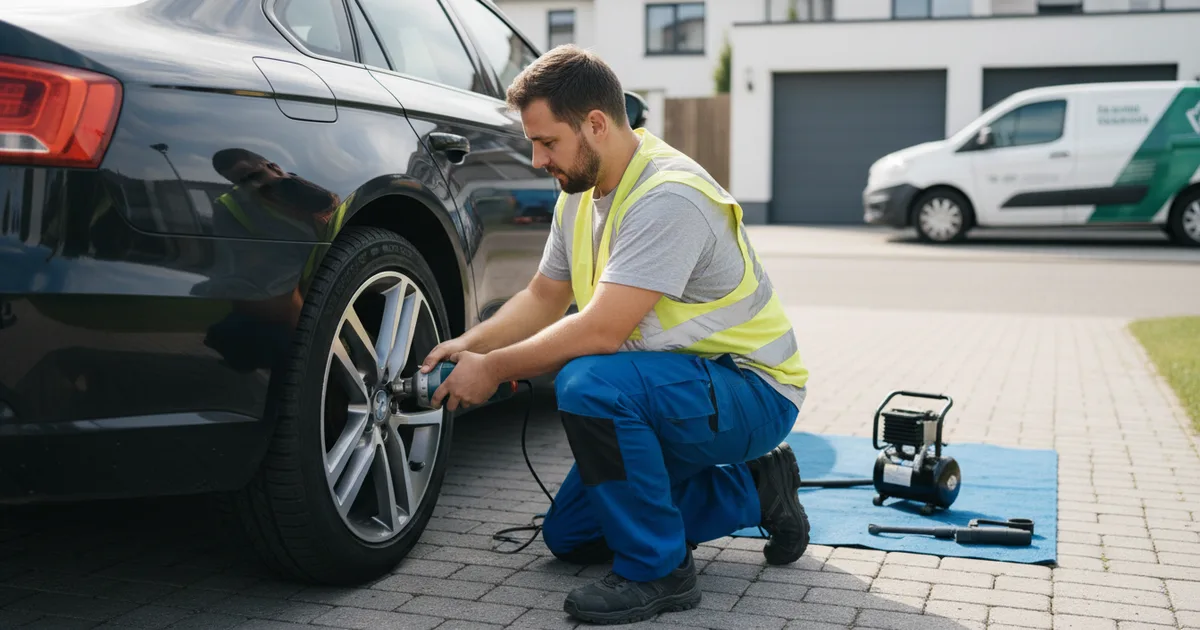
The question we get asked on the driveway
If you're only replacing two tyres and not all four, you'll sometimes see us put the new pair on the back of the car, even if it's front-wheel drive and the front tyres looked more worn. Understandably, that catches people out. The front wheels are usually the ones doing the steering and, on most cars, most of the work. So why would the newest rubber go where it seems to matter less?
The short answer is that it isn't about which axle wears fastest. It's about what happens the moment either axle loses grip, and which of those two situations you're more likely to walk away from without a scare.
The industry standard, not a Tyre Soldier opinion
This isn't a house rule we've made up. It's the position the wider tyre industry recommends: newest tyres go on the rear axle, regardless of whether the car is front-wheel drive, rear-wheel drive or all-wheel drive. Drive layout doesn't change the recommendation, because the reasoning isn't about traction under power. It's about what happens when a tyre lets go in the wet or on a greasy road, and how much warning and control the driver gets when it does.
Front slide versus rear slide
Here's the core of it. When the front tyres lose grip first, the car understeers, it carries on running wide through the corner rather than turning as sharply as you're asking it to. It's not comfortable, but it's a relatively forgiving failure. You feel it building, you can react, and easing off usually brings the car back in line.
When the rear tyres lose grip first, the back of the car can step out. That's a slide that can develop into a spin, and it happens with a lot less warning than understeer does. It's harder to control, harder to catch, and far easier to get wrong under pressure, especially if it happens mid-corner or while you're already correcting for something else on the road.
Put plainly: losing front grip is a problem you can usually drive through. Losing rear grip is a problem that can drive you. Fitting the worn tyres to the front and the new ones to the rear stacks the deck in favour of the more forgiving failure mode if grip runs out on one axle before the other.
Why this matters more on the roads we cover
It's easy to treat this as a technicality until you're actually on a wet B-road in Perthshire in November, or crossing the Tay Bridge in a crosswind with standing water either side of the lane. Fife's coastal routes and the rural stretches around Angus and Perthshire aren't always well-lit, well-gritted, or forgiving of a late reaction. A rear-end slide on a dark, wet road with no streetlights is a much worse place to find out your tyres weren't matched for grip than a straight, dry motorway in daylight. The logic behind rear-axle-first isn't theoretical for anyone driving these roads through a Scottish winter.
What this means when we're at your car
If you're booking us for a replacement and only need two tyres rather than four, don't be surprised if we recommend the new pair goes on the rear, even where the fronts are more worn from steering and braking loads. We'll always talk you through it on the day rather than just doing it without explanation, because we'd rather you understood the reasoning than just trusted us blindly. It's a five-minute conversation and it's your car, so you should know why we're doing what we're doing.
This is also one of the reasons we'd rather do the job properly at your home or workplace than have you nurse a mismatched set to a garage across town. Our mobile tyre fitting service means the axle positioning gets sorted correctly on the spot, at the pressure and torque settings the car needs, rather than being an afterthought because someone was in a hurry.
The bottom line
New tyres on the rear isn't about babying the axle that "matters less". It's a deliberate safety choice: if one end of the car is going to lose grip before the other, you want it to be the front, because that failure is the one an average driver can catch. Whatever you drive, front, rear or all-wheel drive, that logic holds. Next time you're only replacing a pair, don't be surprised where they end up, and don't hesitate to ask us why.