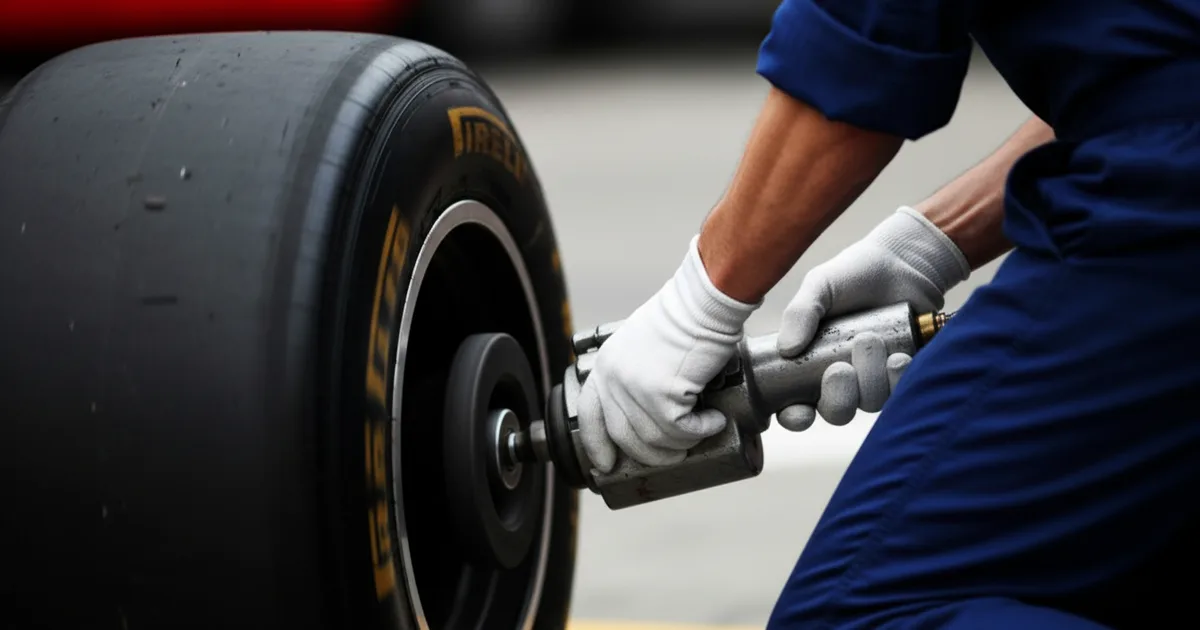
Watch any Formula 1 race and you'll hear commentators talk about tyre degradation like it's a problem the teams are fighting against. It isn't. The tyres are built to wear out at a specific rate, and that's not a flaw in the design, it's the design itself. Most people assume the goal is a tyre that lasts the whole race without falling off a cliff in performance. In F1, that would actually ruin the sport.
A tyre that never wears out would be bad for racing
If F1 tyres held their peak grip for an entire race distance, there would be no pit stops, no strategy calls, and very little reason for one car to overtake another. Degradation is what forces teams to make decisions. Pit now and take the undercut, or stay out and hope the tyre holds long enough to make one lap on old rubber worth more than a lap on fresh rubber for your rival. None of that exists without a tyre that is engineered to lose performance on a curve the teams can predict and plan around.
That's the part that's easy to miss from the sofa. The teams aren't just reacting to wear, they're calculating it in advance. Tyre suppliers build compounds with a known degradation profile, and race engineers build entire strategies around exactly when that curve is going to bite. A tyre that behaved unpredictably would be useless for this. A tyre that never degraded at all would remove the need for strategy altogether. So the compound is tuned to wear at a rate that's fast enough to matter and consistent enough to plan for.
Wear as a tactical weapon, not just a consumable
This is the real shift in how to think about it. In most contexts, tyre wear is simply a cost, a part that degrades and eventually needs replacing. In F1, wear is a tool the teams actively use against each other. A driver on tyres ten laps fresher than the car ahead has a tactical advantage that has nothing to do with raw driver skill, it's entirely down to where each car sits on its own degradation curve. Undercuts, overcuts, two-stop versus one-stop strategies, all of it exists because the tyre is deliberately not built to last.
It's worth being clear that this is the opposite of what most people want from a tyre in everyday life. Nobody wants their road tyres to wear out faster so their neighbour has more overtaking opportunities on the school run. The entire point of the deliberate degradation in F1 is that it serves the race as a spectacle and as a competition. Road tyres are engineered for the opposite outcome: predictable, gradual wear that gives you as many safe miles as possible before it matters.
What this actually has in common with the tyres on your car
Here's where the comparison is genuinely useful rather than just a bit of trivia. Every tyre, whether it's on a Formula 1 car doing 200mph around Silverstone or a hatchback doing the school run through Perth in the rain, wears down through the same basic mechanism: rubber compound losing material and grip through friction and heat cycles. F1 just turns the dial deliberately to make that wear happen fast and predictably, for competitive reasons. Your road tyres are engineered to slow that same process down as much as possible, but the underlying physics is identical.
The practical difference is that nobody is planning a pit stop for your car. If a front tyre degrades unevenly because of a slow puncture, poor alignment, or just age, you don't get a strategist on the radio telling you when to come in. You get reduced grip in the wet, longer braking distances, and an increased risk of a blowout, none of which is a fair trade for road driving. Tayside and Fife roads see a fair share of standing water and loose surface debris after weather rolls in off the hills, and that's exactly the kind of condition where a worn tyre stops behaving predictably in ways an F1 strategist would actually appreciate but you really don't want on the A90.
Checking wear isn't optional off the track
The lesson from F1 isn't that wear is bad, it's that wear is something you should always know the state of, whether you're deliberately managing it lap by lap or just making sure it doesn't catch you out on a wet commute. Teams check tyre data constantly during a race because the margins are that tight. You don't need to check yours every ten laps, but tread depth and even wear across all four corners are worth a look more often than most drivers manage.
If it's been a while since anyone's actually looked at yours, or you're not sure whether a tyre is past the point of being safe, that's a straightforward thing to sort without needing to book a garage slot around your day. We come out to you across Tayside, Perthshire and Fife and handle it on the spot through our mobile fitting service, no trailer to the depot required. Same principle as the pit lane, just less urgent and with better tea.