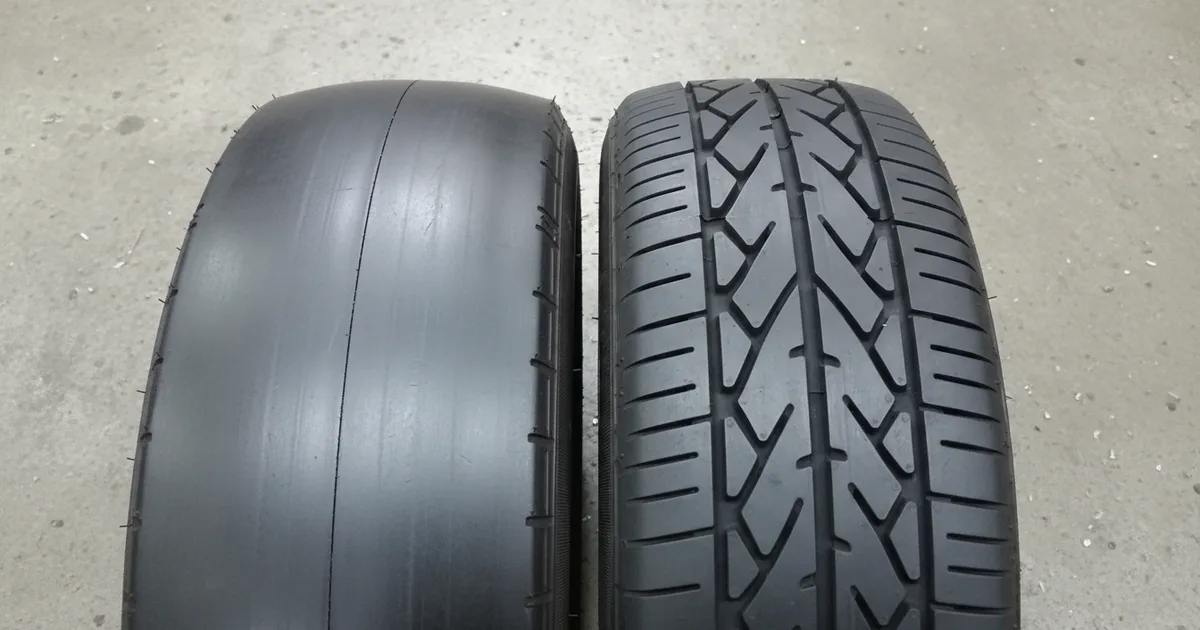
Most drivers assume the grooves cut into a tyre are what give it grip. More tread, more bite, more traction, that's the logic. It's wrong, and it's worth understanding why, because it changes how you think about tread depth and tyre choice.
The bit that surprises people
On a dry road, a tyre with no tread at all grips better than one with a normal pattern cut into it. That's not a theory, it's why racing slicks exist. A slick tyre puts the maximum possible amount of rubber in contact with the tarmac at every point around the contact patch. No grooves, no gaps, just rubber on road. On a dry surface that's the best grip you can get, which is exactly why every serious dry-weather racing tyre is smooth.
So if slicks are the fastest thing on a dry track, why doesn't every road tyre look like one? Because roads aren't always dry, and a slick tyre on a wet road is dangerous.
What the grooves are actually doing
The pattern cut into a normal tyre exists almost entirely to deal with water. The grooves give water somewhere to go. Without them, a film of water builds up between the rubber and the road surface and the tyre starts to ride on top of it instead of gripping through it. That's aquaplaning, and it's the main reason tread patterns exist at all.
Beyond shifting water, the grooves do a few other jobs too. They cut down road noise, since a smooth tyre rolling on a rough road surface produces a lot more drone than a patterned one. And the design of the pattern affects how evenly a tyre wears over its life, which is part of why different tyres last different lengths of time even on the same car.
Take the tread away and none of that happens. A slick has no channels for water to escape through, no way to quieten road noise, and a wear pattern that isn't engineered in the same way. That's fine on a dry racetrack with no rain forecast. It's not fine on a road that gets rained on regularly.
An easy way to picture it
If roads were always bone dry, every tyre on sale would be built close to a slick. There'd be no reason to cut grooves into anything, because there'd be no water to move and grip would only get better as you removed material. Tread only exists because weather exists. The wetter and more variable the conditions, the more a tyre depends on its grooves doing their job properly.
That's the reality for anyone driving across Tayside, Perthshire or Fife. Dry, grippy tarmac isn't something you can rely on for long stretches here. Rain, standing water on back roads, and wet leaves in autumn are part of normal driving, not an occasional inconvenience. A tyre's tread pattern is doing real work on those roads far more often than it's sitting idle on a dry, sunny run.
Why this matters once tread wears down
This is also why worn tread is a genuine safety issue rather than just an MOT technicality. As the grooves get shallower, there's less room for water to escape through, and a tyre starts behaving more like a slick in exactly the conditions where a slick is a liability, on a wet, ordinary road rather than a dry racetrack. The tyre doesn't announce this gradually and safely. Grip can fall away quickly once tread depth gets low, especially at speed or with standing water on the surface.
It's worth checking tread depth properly rather than guessing by eye, since a tyre can look fine at a glance while sitting close to the legal minimum. If you're not sure where yours stand, or you've noticed a car feeling less settled in the wet, it's worth having them looked at rather than waiting for an MOT to flag it. We fit and check tyres at the roadside or at home across the area, so getting worn ones sorted doesn't need a trip to a garage, you can book mobile tyre fitting and have it dealt with wherever the car is parked.
None of this means tread pattern design is complicated to understand, it's actually a fairly simple trade-off. Remove the grooves and you get maximum dry grip but no way to handle water, noise or wear. Add grooves and you lose a little outright dry grip in exchange for a tyre that copes with rain, keeps quiet, and lasts. For anything other than a dry racetrack, that trade-off is the right one, and it's the reason every road tyre you'll ever fit has a pattern cut into it rather than a bare strip of rubber.