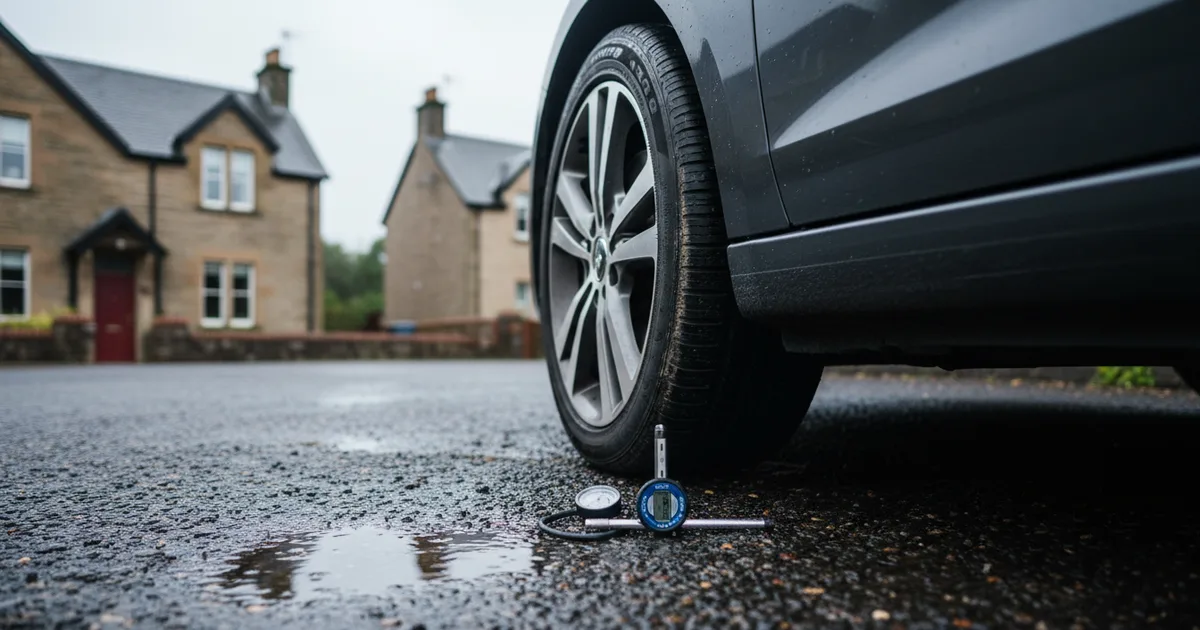
Uneven tyre wear is one of the clearest warning signs a car can give you. It is not just a cosmetic problem, and it is not something to ignore until the next MOT. A tyre can still have legal tread in one area while being badly worn in another. That means less grip, poorer braking, more road noise, and a higher chance of a blowout or puncture.
Around Tayside, Perthshire and Fife, tyres work hard. You have city driving in Dundee, fast A roads, wet rural lanes, coastal routes, farm traffic, speed bumps, sharp kerbs, and plenty of winter road grit. All of that can show up in the tread. If you know what the wear pattern means, you can often catch the cause early and save yourself a breakdown.
Wear on both outer edges
If both shoulders of the tyre are worn more than the centre, the most common cause is under inflation. When a tyre is low on pressure, the middle of the tread lifts slightly and the outer edges carry too much of the load. This builds heat and wears the shoulders down faster.
Under inflated tyres also use more fuel and make steering feel heavy. On wet roads, they can feel vague and slow to respond. Check pressures when the tyres are cold, using the pressures listed for your car, not the number printed on the tyre sidewall. The sidewall figure is a maximum rating, not the normal running pressure.
Wear down the centre
If the centre of the tread is wearing faster than both edges, over inflation is usually the first thing to check. Too much air pressure rounds the tread shape, so the middle section takes more of the load than it should.
This can reduce the contact patch and make the tyre less comfortable over rough surfaces. It can also increase the chance of damage if you hit a sharp edge or rough drain cover. Again, use the car manufacturer's pressure guide and remember that pressures may be different when the car is fully loaded.
Wear on one edge only
Heavy wear on just the inner or outer edge often points to wheel alignment, worn suspension parts, or damage after a kerb strike. This is common after clipping a kerb in a tight street, dropping into a rough verge, or hitting road damage at speed.
One edge wear is easy to miss because the worst part is often on the inner shoulder, where you cannot see it clearly by standing beside the car. Turn the steering fully left or right when parked safely, then look across the whole tread width. If the inner edge is close to bald, the tyre may be unsafe even if the outer edge looks fine.
Patchy or cupped wear
Patchy wear, sometimes called cupping or scalloping, looks like high and low spots around the tyre. You may feel it as vibration, droning, or a rhythmic rumble that changes with speed. This can be linked to worn shocks, wheel imbalance, damaged suspension, or a tyre that has been run for too long in poor condition.
On rougher roads across rural Perthshire or inland Fife, suspension wear can creep up slowly. The car may still drive, but the tyre is no longer sitting evenly on the road. If the tread feels lumpy when you run your hand gently over it, get it checked.
Feathered tread blocks
Feathering is when each tread block feels smooth one way and sharp the other way. It is usually caused by incorrect toe alignment, where the wheels are pointing slightly inwards or outwards as the car rolls.
You may notice the steering wheel sitting slightly off centre, the car drifting, or a rasping tyre noise. Feathering can appear before the tyre looks badly worn, so it is worth checking by touch as well as sight. Do this only when the car is parked safely and the tyres are cool.
Cracks, bulges and flat spots
Not all tyre problems are simple tread wear. Cracks in the rubber can come from age, weathering, or the tyre sitting unused for long periods. Bulges in the sidewall are more serious and usually mean internal damage. A bulge should be treated as urgent because the structure of the tyre has been weakened.
Flat spots can happen if a vehicle sits parked for weeks, or after heavy braking. Some small flat spots settle after driving, but a strong thump or vibration should be checked. A tyre that is out of shape is not something to gamble with on faster roads like the A90 or A9.
How often should you check?
A quick tyre check once a fortnight is sensible, and always before a longer trip. Look across the full width of each tyre, not just the outside edge. Check tread depth, pressure, cuts, nails, screws, cracking, and any unusual shape. If you tow, carry tools, or run a van, check more often because extra weight increases tyre load and heat.
Uneven wear also affects pairs of tyres. If one tyre has worn badly because of pressure or alignment, the tyre on the same axle may be affected too. Replacing one tyre without fixing the cause can mean the new one wears out early as well.
When a tyre needs replacing
If the tyre is worn unevenly, damaged, or close to the legal limit, do not wait for it to fail. A mobile fitter can come to your home, work, roadside location, or yard and replace the tyre without you driving further on it. The Tyre Soldier offers mobile tyre fitting across Dundee, Tayside, Perthshire and Fife, including out of hours support where needed.
The main point is simple: tread patterns tell a story. If the wear looks odd, there is usually a reason. Catch it early and you protect your tyres, your steering, your fuel economy, and your grip when the weather turns foul.