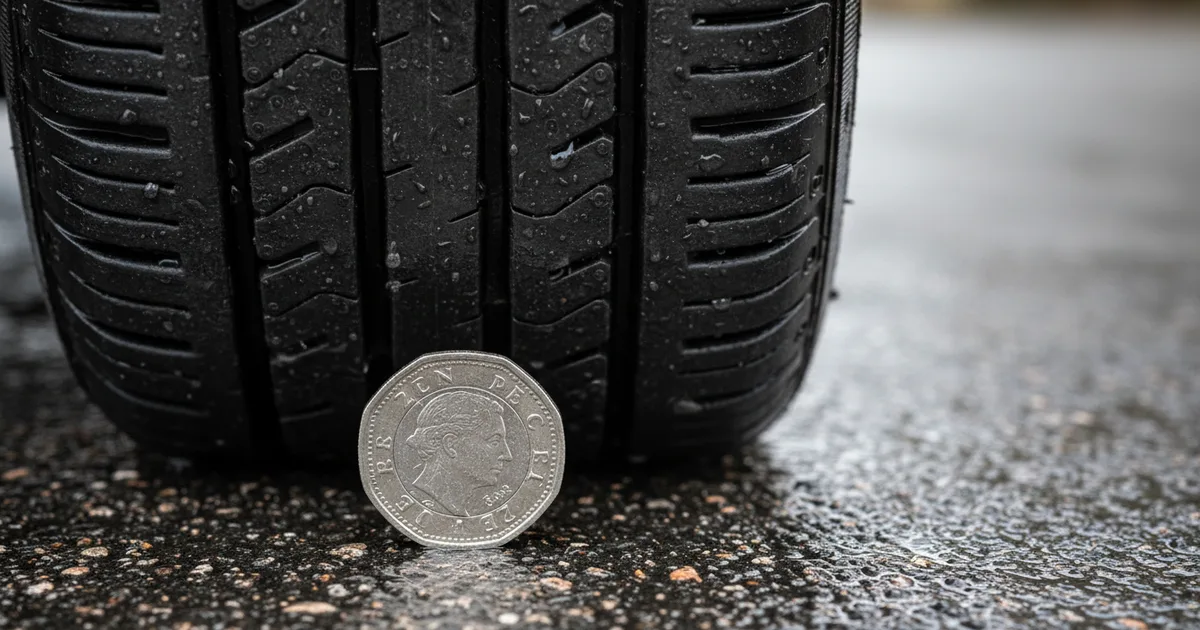
Tyre tread is easy to ignore until the car starts feeling poor in the wet. Around Dundee, Perthshire and Fife, that is a bad habit. Our roads see plenty of rain, standing water, greasy roundabouts, farm traffic, and fast changes from town streets to country roads. Good tread is not just about passing an MOT. It is what helps your tyres clear water, grip the road, and stop the car when you need it.
This guide keeps it simple: what the law says, how to check your tread, and when it is sensible to replace tyres before they become a problem.
What is the legal tyre tread depth in the UK?
For cars, vans, and light trailers in the UK, the legal minimum tread depth is 1.6mm. That depth must be across the central three quarters of the tyre, all the way around the full circumference.
If any part of that main tread area is below 1.6mm, the tyre is illegal. You could face a fine and penalty points, but the bigger issue is safety. A tyre at the legal limit has far less wet grip than a tyre with healthy tread.
For motorbikes and larger vehicles, the rules can differ, so check the correct standard for what you drive. For most local car and van drivers, 1.6mm is the figure to remember.
Why 1.6mm is not always enough
The legal limit is the absolute minimum, not the point where a tyre is at its best. Many tyre manufacturers and garages recommend changing tyres at around 3mm, especially if you drive in wet areas or do regular motorway and A-road miles.
At 3mm, your tyres can still move water away from the contact patch more effectively. Once tread gets close to 1.6mm, braking distances in the wet can increase sharply. On roads like the A90, A92, A9, Kingsway, or rural routes through Perthshire, that extra stopping distance matters.
If your tread is low and you hit heavy rain near Invergowrie, Cupar, Forfar, or Crieff, the tyre has less room to clear water. That raises the risk of aquaplaning, where the tyre rides on top of water instead of gripping the road.
How to check tread depth at home
The best way is with a proper tread depth gauge. They are cheap, easy to use, and more accurate than guessing. Check several points across each tyre, including the inner, centre, and outer tread. Also check around the tyre, not just in one place.
You can also use the built-in tread wear indicators. These are small raised bars set inside the tread grooves. When the tread is level with those bars, the tyre is at about the legal limit and needs replacing.
The 20p test is a quick roadside check. Put a 20p coin into the main tread groove. If you can see the outer band of the coin, the tread may be too low and should be measured properly. It is a useful guide, but it does not replace a gauge.
Check all four tyres, not just the fronts
Front tyres often wear faster on front-wheel-drive cars, which are common around here. They do the steering, much of the braking, and put the power down. Rear tyres can still become unsafe, especially if they are old, cracked, or worn unevenly.
Do not assume a tyre is fine because it has tread in one spot. Uneven wear can leave the inner edge close to illegal while the outer edge looks acceptable. This is common when tracking is out, suspension parts are worn, or the car has taken kerbs hard over time.
If you cannot see the inner edge properly, turn the steering where possible and use a torch. For rear tyres, you may need to crouch down and look from behind the wheel. It is worth the extra minute.
Signs your tread is not wearing properly
Uneven tyre wear can point to a bigger issue. Feathering across the tread can suggest alignment trouble. Heavy wear on both shoulders may suggest underinflation, while centre wear can suggest overinflation. One-edge wear can mean tracking, camber, or suspension problems.
You might also notice the car pulling to one side, vibration through the steering wheel, or more road noise than normal. If those signs appear, do not just fit new tyres and forget about it. Get the cause checked, or the new tyres may wear out early too.
When should you replace tyres?
Replace tyres immediately if they are at or below the legal limit, have exposed cords, bulges, deep cuts, or sidewall damage. You should also replace them if cracking is visible, even when tread depth looks acceptable. Rubber hardens with age, and old tyres lose grip.
If your tyres are between 2mm and 3mm, think about your driving. If you mainly do short town trips in fair weather, you may have a little time. If you drive at night, on fast roads, in heavy rain, or through rural Perthshire and Fife in winter, replacing closer to 3mm is the safer call.
For drivers who cannot get to a garage, mobile fitting can save time and keep the car off unsafe roads. The Tyre Soldier offers mobile tyre fitting across Dundee, Tayside, Perthshire and Fife, so tyres can be fitted at home, work, or roadside where suitable.
A simple monthly habit
Once a month, take five minutes to check tread depth on all four tyres. Do it before longer trips, before winter weather sets in, and before MOT time. Look for low tread, uneven wear, cracks, bulges, nails, and any change in how the car feels.
Good tyres are not exciting, but they are one of the most important parts of the car. On local roads that can go from dry to soaked in minutes, healthy tread gives you better braking, better steering, and a safer drive.