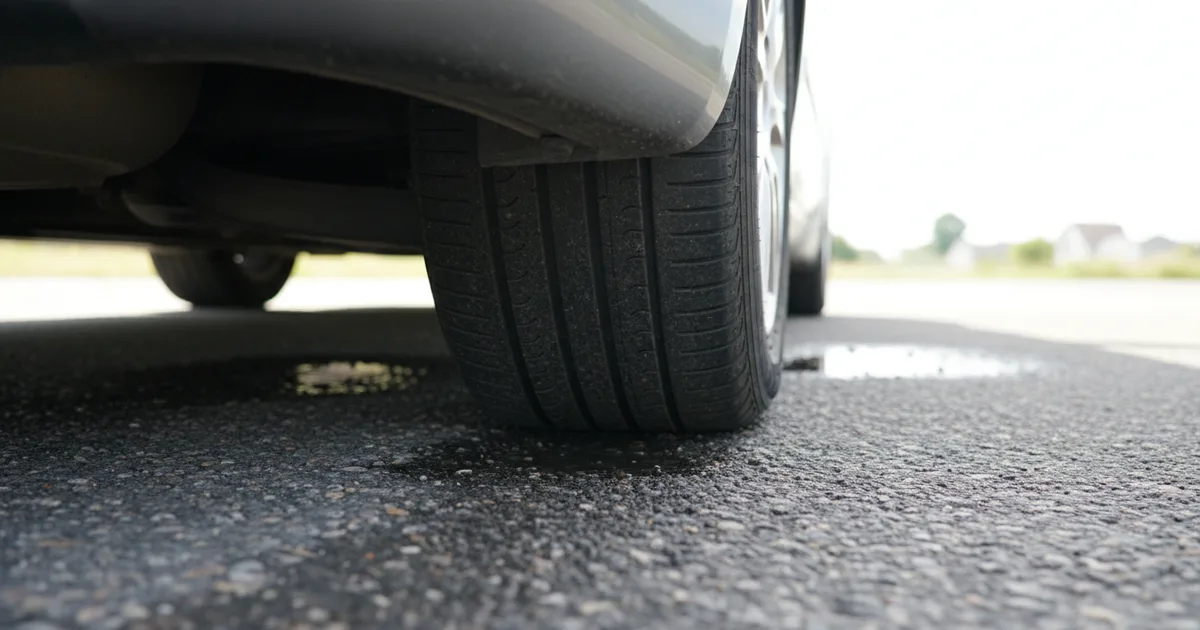
Stand next to your car and look down at where the tyre meets the tarmac. That's it. That's the whole connection between a couple of tonnes of metal, glass and passengers and the road surface. It's not a lot to look at, and that's exactly the point.
How small are we talking
For a typical car weighing around 1,600 kg, the total contact patch area across all four tyres works out at roughly 600 to 800 square centimetres. Split that four ways and you get about 150 to 200 square centimetres per tyre, which is about the size of a postcard. Not your hand flat on the table, not a dinner plate, a postcard. Four of them, one under each corner of the car, is the entire footprint your vehicle has on the road at any given moment.
It sounds like it shouldn't be enough. A car weighs as much as a small van, yet it's balancing and moving on an area you could cover with four envelopes. But that's how tyres are designed to work, and under normal conditions with tyres in good condition, it's enough, because the rubber compound and tread pattern are doing a lot of work in that small space.
Everything happens through that patch
Here's the part that's easy to forget when you're driving. Every single thing your car does physically to the road, and everything the road does back to your car, happens through those four small patches. Accelerating happens there. Braking happens there. Steering input, the actual turning of the car in the direction you want, happens there. The entire weight of the vehicle is carried there. And every bump, pothole, ridge and camber change in the road surface gets absorbed and dealt with there too.
There's no backup mechanism. There's no secondary contact point that kicks in if the tyre's not gripping properly. Whatever that patch of rubber can transmit to the road is the maximum amount of grip, braking force and steering response your car has available to it at that moment. If the patch is compromised, whether that's from low tread, wrong pressure, a damaged sidewall or worn-out rubber that's gone hard and glassy, the car isn't running at reduced performance in some abstract sense. It's running with a smaller, less effective postcard doing the same job.
Why this matters more on roads like ours
Around Tayside, Perthshire and Fife, that postcard-sized patch is working harder than the number suggests. Rural routes with standing water, sudden temperature drops, and the kind of loose grit and debris you get off farm tracks and B-roads all put more demand on the same tiny contact area. A tyre that's got plenty of tread and the right pressure spreads load evenly across that patch and channels water and debris away from it. A tyre that's under-inflated, unevenly worn, or past its best does the opposite, and it's doing it on the exact same postcard of rubber, at the exact same moment you need it to hold the road on a wet bend or a frosty morning.
This is also why little things that seem minor, a tyre a few PSI under pressure, tread depth getting close to the legal limit, uneven wear from a mildly out of alignment track rod, actually matter more than they look like they should. They're not small percentage losses spread across a big surface. They're changes to the shape and grip of a patch that's already tiny to begin with.
What actually keeps the patch working properly
None of this is complicated to manage. Correct tyre pressure keeps the patch the right shape, flat and even rather than bowed in the middle or squeezed at the edges. Adequate tread depth keeps water and debris clearing out from underneath it instead of building up and lifting the tyre off the surface. And tyres free from cracking, bulges or uneven wear keep the rubber doing what it's meant to do rather than losing grip unevenly across that small area.
Checking pressures and tread is a five-minute job most people can do themselves. Where it gets harder is when a tyre needs replacing and you don't have the time to sit in a garage waiting room, or the tyre's degraded to the point where driving it there isn't sensible. That's where a call-out fitter earns its keep, coming to your home, workplace or roadside and doing the job on the spot. If you'd rather not deal with any of it yourself, our mobile tyre fitting service covers Tayside, Perthshire and Fife and gets a fresh, correctly fitted tyre under your car without you needing to go anywhere.
Four postcards. That's what's actually holding your car to the road. Worth keeping them in good shape.