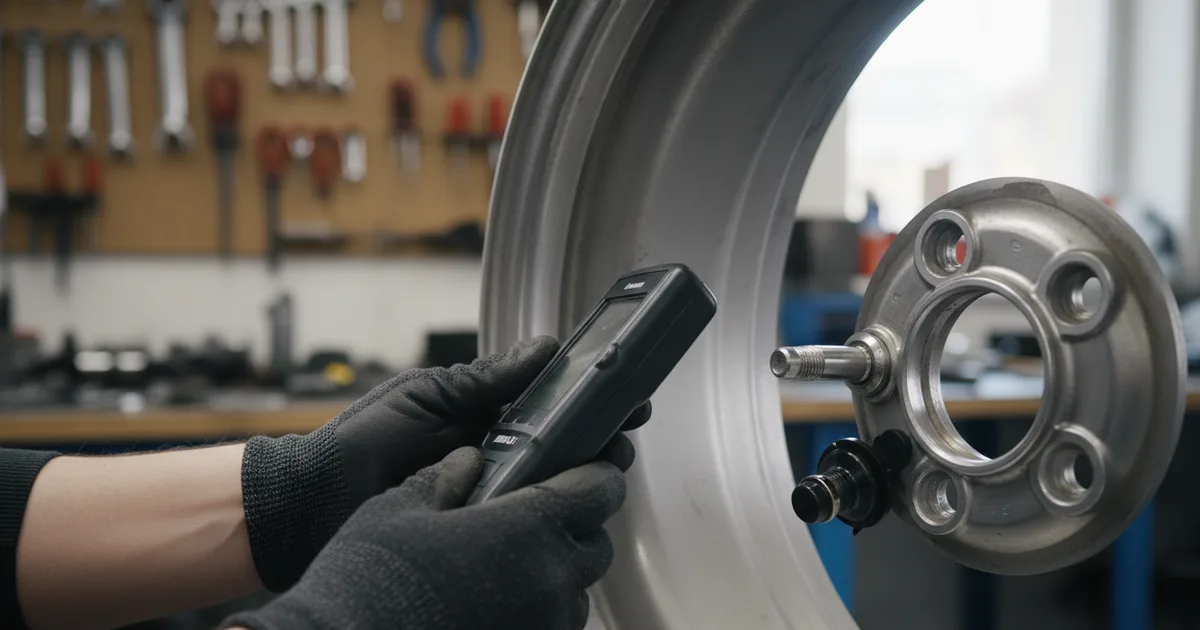
Most drivers only think about the little tyre-shaped warning light on the dashboard when it comes on and won't go off. That light is the visible end of a tyre pressure monitoring system, TPMS, and the sensor behind it is a small piece of hardware sitting inside the wheel that needs proper attention every time a tyre gets changed. Skip that step and the warning light problem doesn't go away, it just moves to whoever owns the car next.
What TPMS actually is
Since 2014, new cars sold in the EU and UK have been required to carry a tyre pressure monitoring system, and most cars on the road now have one. There are two main types. A direct system has a small sensor mounted inside each wheel, usually on the valve stem, that measures actual air pressure and sends it to the car electronically. An indirect system doesn't measure pressure at all, it compares wheel speed sensor data through the ABS system and infers that a tyre is low because it's spinning slightly faster than the others, since a low tyre has a smaller rolling radius.
Direct systems are more accurate but rely on physical sensors with their own batteries, typically lasting somewhere between five and ten years. Indirect systems have no sensor to fail but need recalibrating any time a tyre is changed, or the readings drift and become meaningless.
Why fitting a tyre disturbs the system
On a direct system, removing and refitting a tyre means the sensor, sitting inside that wheel, gets handled along with everything else. It can be knocked, the valve core might need replacing at the same time, and the car's onboard computer often needs to be told which sensor is now in which wheel position, particularly if wheels have been swapped or rotated. That's the "relearn" or "reset" procedure, and different manufacturers require different methods, some through a simple dashboard menu sequence, others needing a dedicated diagnostic tool plugged into the car.
On an indirect system, the fix is simpler in one sense, the car just needs to be told the tyres are now correctly inflated so it can reset its baseline rolling radius for each wheel. But if that reset step gets missed, the warning system is comparing new tyres against an old baseline, and the light can stay on, or worse, fail to warn about a genuine problem later because the comparison is already wrong.
What happens when this gets missed
A tyre change that skips the TPMS step tends to show up in one of two ways. Either the warning light stays lit after the car's back on the road, which is at best an annoyance and at worst something a driver starts ignoring altogether, or the system quietly stops giving accurate warnings because its baseline was never updated. Neither outcome is acceptable given the whole point of the system is to catch a slow puncture or underinflated tyre before it becomes a bigger problem or a roadside failure.
It's also worth knowing that a failed sensor battery on a direct system doesn't always announce itself clearly, sometimes it's a permanently lit warning light, sometimes it's an intermittent one. If a car's been showing a TPMS fault that nobody's got to the bottom of, it's often traced back to a sensor that's simply reached the end of its battery life rather than anything wrong with the tyre itself.
What a proper fitting includes
A correct tyre fitting on a car with TPMS means checking the sensor is undamaged, replacing the valve core or the sensor itself if it's due, and carrying out whichever reset or relearn procedure the vehicle needs before the job's considered finished. That's not an upsell, it's part of doing the fitting properly, in the same way torquing a wheel to the correct setting is part of the job rather than an extra.
If your dashboard's showing a TPMS warning that won't clear, or you're due a tyre change and want the sensor checked and reset properly as part of it, our mobile tyre fitting carries the tools to handle both, wherever the car's parked across Dundee, Perth or Fife. A tyre changed correctly should leave that warning light off, not something to keep half an eye on afterwards.