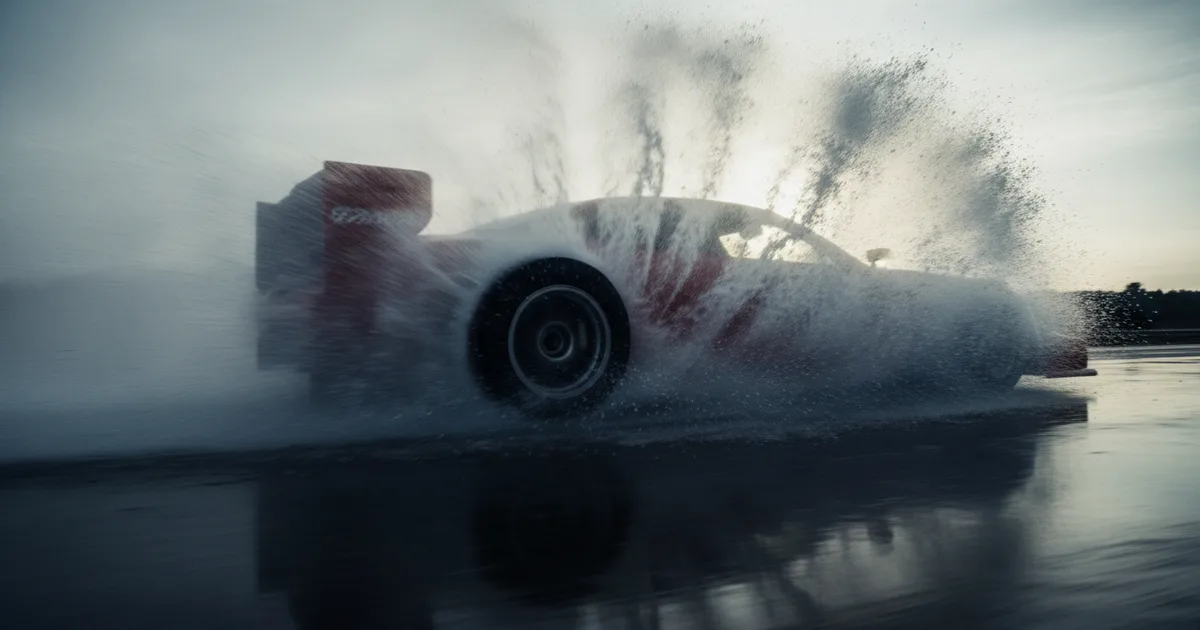
The moment your car becomes a boat
Aquaplaning sounds dramatic because it is dramatic. At speed, a tyre can ride up on top of a film of water and lose contact with the road entirely. When that happens, steering, braking and acceleration all disappear at once. The car is effectively a boat, floating on a thin layer of water instead of gripping tarmac. There is no warning light for this. The first sign most drivers get is the steering going light and unresponsive in their hands.
Why rubber and water don't mix
A tyre's job in the wet is simple to describe and hard to do well. It has to clear the water from underneath itself fast enough that the tread can still touch the road. A tyre's tread has to pump thousands of litres of water away every minute to prevent aquaplaning. That number gives you a sense of the scale of the job. It is not a trickle of water being pushed aside, it is a genuine drainage operation happening under each tyre, every second the car is moving.
What actually pumps the water away
The tread pattern is the pump. The grooves cut into a tyre are channels designed to move water backwards and outwards from the contact patch before the rubber behind them arrives. When a tyre is new, those channels are deep and can move a lot of water quickly. As the tread wears down, the channels get shallower and the tyre's pumping capacity drops with them. A tyre doesn't need to be illegal to be a problem in standing water. It just needs to be worn enough that it can no longer shift water as fast as it once did.
Speed changes the equation fast
Aquaplaning is a function of speed as much as tread. The faster a tyre is travelling, the less time it has to push water out of the way before the next bit of tread arrives at that same patch of road. Slow the car down and the tyre gets more time per revolution to do its job, which is why easing off in standing water matters more than almost anything else a driver can do in the moment. It is one of the few driving hazards where the fix is mostly about what you do with your right foot, not the steering wheel.
Tayside, Perthshire and Fife in the wet
Standing water is not an occasional problem on the roads around Dundee, Perth and into Fife. Low-lying stretches, farm run-off crossing the carriageway and poor drainage on some of the older rural routes all create the exact conditions a tyre has to work hardest against. A driver who has always felt confident on these roads can still be caught out by a set of tyres that have quietly lost the depth needed to keep pumping water away at speed. It is not usually a sudden failure, it is a gradual one that only shows itself the day the road is wet enough to test it.
Checking your own risk
Tread depth is the number that matters most here, because it is the direct measure of how much pumping capacity a tyre has left. A quick depth check across the tyre, not just in the centre, tells you more about aquaplaning risk than looking at the tyre and deciding it "looks fine". Uneven wear across the tread width can leave one part of the tyre with plenty of depth and another part running dangerously shallow, which is easy to miss without actually measuring it.
When it happens anyway
If a car does start to aquaplane, the physics point to the fix. Come off the accelerator, keep the steering as straight as possible, and wait for the tyres to reconnect with the road as speed drops. Fighting the wheel while the car has no grip to respond to just wastes the moment the tyres need to catch up. It is a passive situation to get through rather than an active one to steer out of, which is part of why it catches experienced drivers off guard.
Getting ahead of it
Because tread depth is the variable a driver actually controls, checking it regularly through autumn and winter is worth the two minutes it takes. If a set of tyres is getting close to the legal minimum, or is showing uneven wear, that is the point to deal with it before the next heavy downpour rather than after. For anyone who needs tyres sorted at short notice, whether that's a puncture the night before a wet forecast or worn tread spotted too late, our emergency callout service covers Tayside, Perthshire and Fife around the clock. Getting a fresh set of tyres on before the next spell of standing water is a lot cheaper than finding out on the road how much pumping capacity you had left.