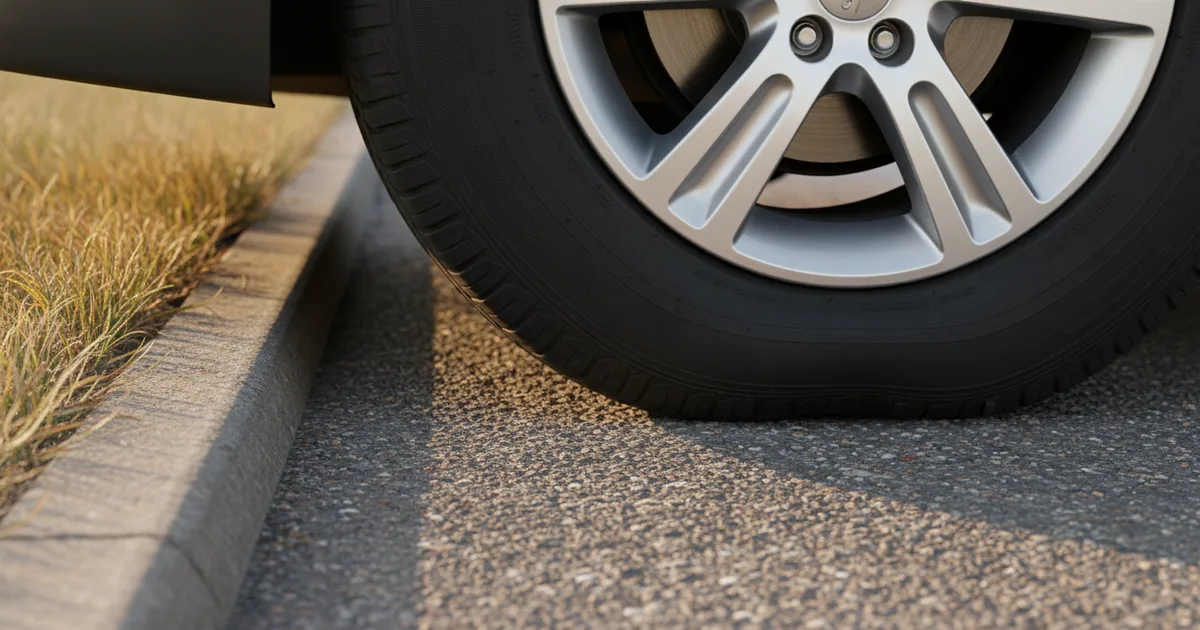
Four jobs, one strip of rubber
The sidewall of a tyre looks like a simple strip of rubber between the tread and the wheel rim, but it is doing four different jobs at once, and each one pulls in a different direction. It has to be soft enough to absorb the small stuff: road noise, minor surface changes, the everyday texture of a British road. It has to be strong enough to survive the big stuff too, a pothole taken at speed, a kerb clipped on a tight turn, a drop into a rut hidden by standing water. It has to be flexible enough to let the tyre corner properly, keeping the contact patch gripping through a bend rather than skating across the surface. And it has to do all of that, comfort, strength, flex, for years, not weeks.
Millions of bends before it is done
Every rotation of a wheel puts a full cycle of stress through the sidewall. It flattens slightly where it meets the road, then springs back as the wheel turns past that point, over and over, thousands of times an hour at motorway speed. A motorway tyre can flex more than 500 million times over its working life before it needs replacing. That is not an exaggeration to make the rubber sound tougher than it is, it is the actual scale of what a sidewall is built to survive: half a billion individual bending cycles, each one a small test of the compound and the structure underneath it.
Why potholes are the real stress test
Comfort and cornering are the everyday demands on a sidewall. Potholes are the demand that actually breaks tyres. A pothole does not just jolt the car, it compresses the sidewall hard against the wheel rim for a fraction of a second, and if the impact is sharp enough it can damage the structure inside without leaving much of a mark on the outside. On the roads we cover across Tayside, Perthshire and Fife that is rarely a hypothetical: b-roads that have taken a battering over a hard winter, farm access tracks with edges that have crumbled, potholes that fill with water and hide their true depth until a wheel is already in them. A sidewall built to survive that kind of impact, and still corner properly, and still manage 500 million bends afterwards, is not asking much of itself.
Damage you cannot always see
Because the sidewall has to stay flexible, it cannot be reinforced the way a tread can. There is no thick block of rubber to armour it, the whole point of the design is that it keeps bending. That is also why sidewall damage is harder to spot than tread damage, and less forgiving when it happens. A bulge, a series of small cracks, a soft patch where the structure underneath has separated from the rubber, these can develop after an impact and get worse under normal driving rather than better. It is why a tyre that has taken a hard hit is worth a proper look rather than a glance, and why a slow puncture that keeps needing air is worth investigating rather than topping up and ignoring. If a valve or a small puncture turns out to be the issue rather than the sidewall itself, that is a straightforward job, we cover it under puncture repair, out at the roadside rather than booked into a garage queue.
What it means for how a tyre performs
None of this shows up on a spec sheet the way tread depth does, but it is the reason two tyres that look identical on the shelf can behave very differently on the same road. A sidewall that is slightly softer will ride more comfortably but may feel less precise into a fast bend. One that is stiffer will corner sharper but transmit more of a pothole straight into the cabin. Manufacturers are balancing those four demands, comfort, strength, flex, durability, against each other every time they design a tyre, and there is no version that maximises all four at once. That is engineering, not marketing: a trade-off, built into millions of bending cycles, that most drivers never think about until a tyre fails in a way that seems sudden but rarely is.
The takeaway for anyone driving these roads
A tyre sidewall is quietly doing more work than almost anything else in a car's contact with the road, flexing for comfort, holding its shape through corners, and absorbing impacts it was never designed to advertise. Over the life of a motorway tyre that adds up to hundreds of millions of individual bends, each one a small chance for a weak point to show itself. Treat a hard impact or a persistently soft tyre as worth checking rather than worth ignoring, because the sidewall rarely gives much warning before it finally gives up.