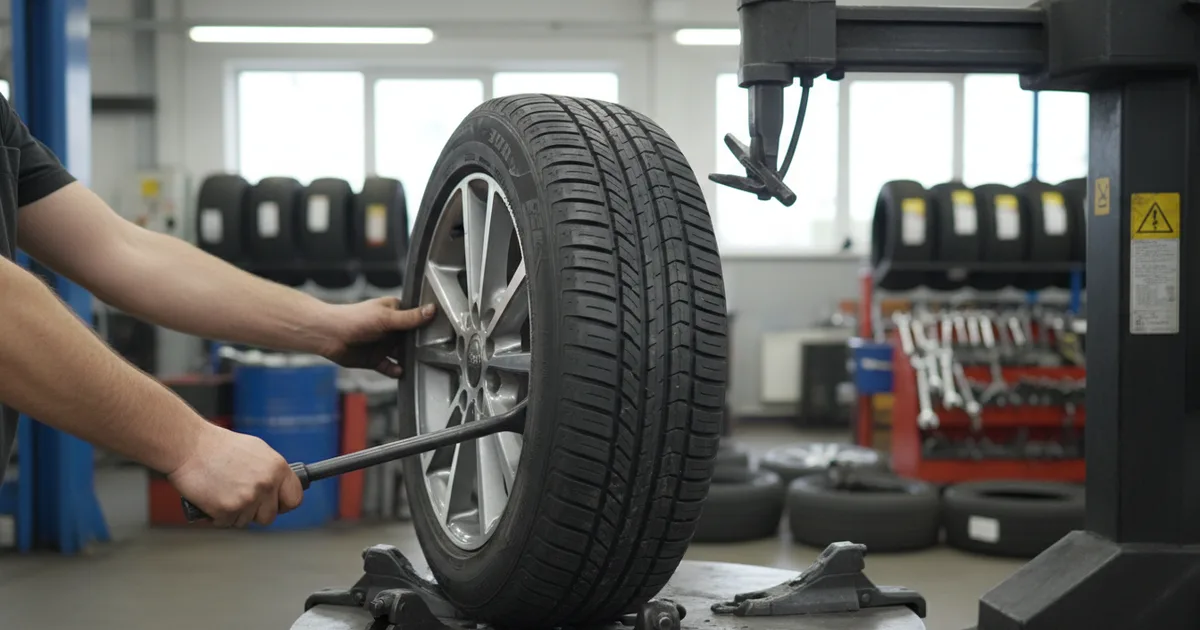
We've written before about why run-flat tyres ride firmer than a standard tyre. What we haven't covered is what actually happens when one gets fitted, and why that job is different from a standard tyre change. The reinforced sidewall that lets you keep driving after a puncture is exactly what makes the fitting itself a more demanding piece of work, and it's worth knowing what that means before you book one in.
Why the sidewall changes the job
A standard tyre's sidewall flexes enough to let a tyre machine break the bead away from the wheel rim without much resistance. A run-flat's sidewall is built to stay rigid even with no air pressure inside it, which is the whole point of the design, but it also means that same sidewall resists being levered off the rim during fitting. Force it with the wrong equipment or the wrong technique and you risk damaging the wheel rim, the tyre bead, or both.
That's why run-flats need a tyre changer with the right clamping and bead-breaking setup for reinforced sidewalls, not just whatever machine happens to be in the bay. It's a genuine reason some garages either won't take run-flat work or take noticeably longer over it. The equipment has to be right for the tyre, not the other way around.
Balancing takes more care too
A run-flat tyre carries more weight in the sidewall itself than a standard tyre does, which shifts how the whole wheel needs to be balanced on the machine. Get the balance slightly wrong on a normal tyre and you might feel a faint vibration at motorway speed. Get it wrong on a stiffer run-flat and that vibration tends to be more noticeable, because there's less flex in the tyre to soak it up before it reaches the steering wheel. A dynamic wheel balancer set up properly for the extra sidewall weight is standard on every run-flat fitting we do.
TPMS is not optional on a run-flat
Almost every car fitted with run-flats from the factory also carries a tyre pressure monitoring system, because a run-flat can lose most of its air with no obvious change in how the car drives. Without a working sensor telling the driver there's a problem, a slow puncture on a run-flat can go completely unnoticed until the tyre itself has been damaged from running underinflated for too long.
That means resetting or relearning the TPMS sensor is part of a correct run-flat fitting, every time, not an add-on. Skip that step and the dashboard warning light either stays on when it shouldn't, or worse, fails to warn the driver when it actually needs to. We treat a TPMS check as a required part of the job, the same as torquing the wheel correctly.
Why you usually can't just fit one
Run-flats need to be matched across an axle, and on most cars across all four positions, because mixing a run-flat with a standard tyre changes how the car handles in a way that isn't predictable or safe. If one run-flat is damaged beyond repair, which is common given they generally can't be plugged the conventional way once the sidewall's been compromised, the replacement needs to match what's already on the car rather than being whatever's cheapest or in stock that day. That's worth knowing before a single tyre gives out unexpectedly, so there's no surprise about what the replacement needs to be.
What this means for booking a fitting
None of this is a reason to avoid run-flats if your car came with them or you've decided the convenience is worth the trade-offs. It's a reason to make sure whoever fits them has the right kit and takes the TPMS step seriously, whether that's a fixed garage or a mobile fitter working from your driveway. A run-flat fitted with the wrong equipment or without a proper sensor check can leave you with a vibration, a dashboard warning that won't clear, or a tyre pressure problem nobody would have noticed otherwise.
Our mobile tyre fitting carries the equipment needed for run-flat work as standard, including the balancing and TPMS reset, wherever the car happens to be parked across Tayside, Perthshire or Fife. If you're due a run-flat replacement and want it done properly the first time, that's exactly what the job should involve.