Grip is not glue
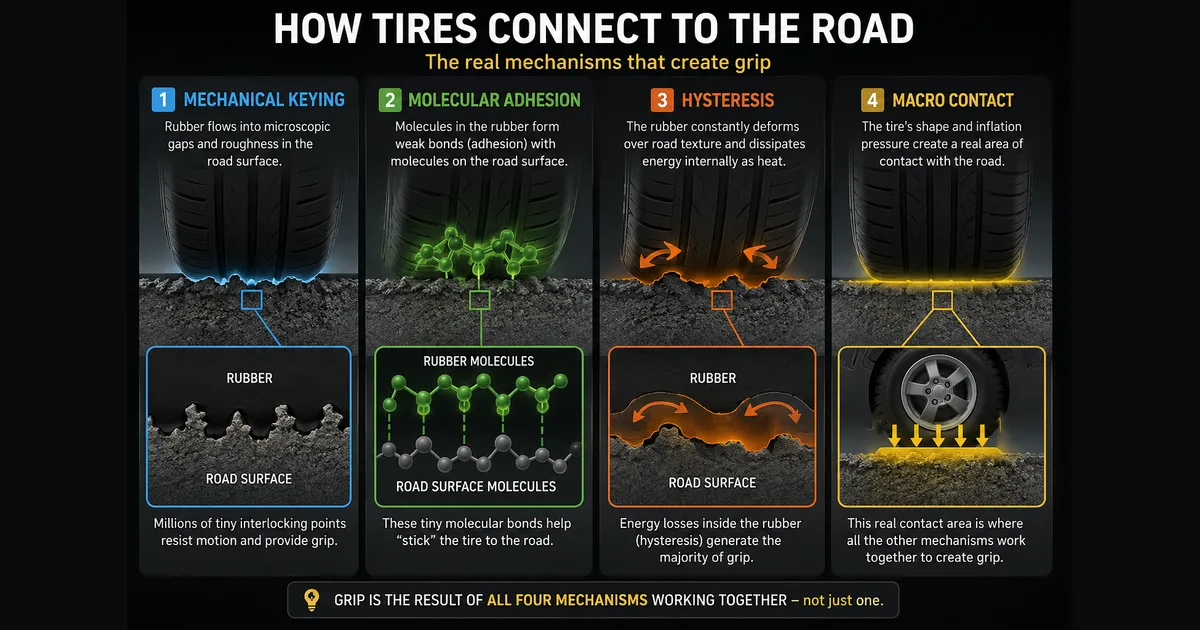
Most drivers picture tyre grip as something like sticky tape: the rubber sticks to the road and that is that. It is not that simple, and understanding what is really happening under a moving tyre explains why worn tread, cold weather and wet roads all hurt braking and cornering in different ways. There are four separate mechanisms working together every time a tyre touches tarmac. Lose one of them and the car handles differently, even if the other three are still doing their job.
Mechanical keying: rubber flowing into the road surface
Tarmac is rough at a microscopic level, full of tiny peaks and gaps that are invisible to the eye but very real to a tyre. As the rubber rolls under load, it flows slightly into those gaps and around those peaks, millions of tiny interlocking points forming and releasing with every rotation. This is mechanical keying, and it is one of the reasons a soft, fresh tyre grips better than a hard, worn one: softer rubber flows into the road texture more readily.
Molecular adhesion: a weak chemical bond
At an even smaller scale, the molecules in the rubber form weak bonds with the molecules on the road surface itself, similar in principle to how a gecko's foot works, just far weaker and over a much larger contact area. This adhesion is real, but on its own it would not explain anywhere near the grip a tyre actually produces. It is one layer of several, not the whole story.
Hysteresis: the biggest contributor
The largest source of grip is hysteresis, the energy lost as rubber constantly deforms over road texture and springs back, over and over, thousands of times a second at speed. That deformation is not perfectly efficient. Some of the energy is lost as heat inside the rubber, and that internal energy loss is what generates the majority of a tyre's grip. It is also why tyre temperature matters so much, a cold tyre has less give in the rubber and produces noticeably less grip until it warms up, which is exactly why the first few minutes of a journey on a frosty morning feel different from the rest of the drive.
Contact area: what the tyre's shape and pressure create
None of the above works without an actual area of contact between the tyre and the road, and that contact patch is created by the tyre's shape and its inflation pressure. Correct pressure keeps the tread flat against the road across its full width. Under or over-inflated tyres change that contact area, concentrating wear and load on the wrong part of the tread and reducing the effective grip even though the compound itself has not changed. This is one reason a pressure check and a tread check belong together, not as separate jobs.
Why this matters on Tayside, Perthshire and Fife roads
All four mechanisms lean on the same thing: enough tread depth and a healthy, correctly inflated tyre in reasonable condition. Worn tread reduces the rubber's ability to flow into the road surface and reduces the water-clearing grooves that keep the contact patch in touch with tarmac rather than a film of water. Low tread and low grip go together for a physical reason, not just a legal one. On the mixed roads around Dundee, Perth and Fife, from fast A-roads to wet rural lanes, that margin matters more than it does on a dry motorway in summer.
If your tyres feel like they are losing grip under braking or in the wet, it is worth getting them checked rather than guessing. A mobile tyre fitting visit can check tread, pressure and overall condition on your driveway and replace what needs replacing, without you needing to find a garage slot.
The short version
Grip comes from rubber flowing into road texture, a weak molecular bond, energy lost as the rubber deforms, and a real contact area created by shape and pressure. All four working together is what lets a tyre do its job. Take one away, through worn tread, wrong pressure or cold rubber, and the car will not behave the way it did when the tyre was fresh.