The rubber isn't doing the heavy lifting
Most drivers look at a tyre and see rubber. Thick tread, sturdy sidewall, a solid-looking wheel. It's easy to assume that's what's holding the car up. It isn't. A tyre is really just a flexible container built to hold compressed air, and it's that air, not the rubber around it, that carries the full weight of your vehicle. The rubber's job is to contain the air and grip the road. The actual load-bearing work is done by pressure.
Think of a tyre less like a solid lump of material and more like a very tough balloon shaped to fit a wheel rim. Squeeze a deflated balloon and it folds flat under almost no weight at all. Inflate it and it becomes rigid enough to push back against a load. Tyres work on exactly the same principle, just at a much higher pressure and with a far tougher skin around the air.
Why a tyre needs pressure to work at all
A tyre is a highly pressurised structure. That's not a side detail, it's the entire basis of how it functions. Every part of a tyre's design, the shape of the sidewall, the way the tread sits flat against the road, the way it absorbs a pothole without folding, only works because there's air inside pushing outward with enough force to keep the structure rigid under the weight of a car pressing down on it.
Take the air away and that structure has nothing left holding it up. Without air, a tyre collapses immediately and cannot support the car. It doesn't gradually get worse or become a bit wobbly, it simply stops being able to do its job. A tyre with no air in it is not a soft version of a working tyre, it's not a tyre at all in any functional sense. It's just a rubber shell with nothing to keep its shape.
What this means for how you actually drive
Once you see a tyre as a pressure vessel rather than a solid object, low pressure stops looking like a minor inconvenience and starts looking like what it is: a structural problem. A tyre running well under its correct pressure is being asked to carry the same weight as a properly inflated one, but with less of the air pressure doing the actual work. The tyre has to flex more to compensate, which is why underinflated tyres run hotter, wear unevenly along the edges of the tread, and feel vaguer to steer.
It also changes how you should think about a slow puncture. A tyre losing air gradually isn't just "getting a bit soft", it's steadily losing the pressure that's holding the car up on that corner. The rubber hasn't changed. The structure supporting your wheel is quietly being taken away, right up until there isn't enough of it left and the tyre gives up entirely, often at the worst possible moment.
Driving around Dundee, Perth or through Fife, that moment tends to arrive on a motorway slip road, a country lane with a hard shoulder that isn't really a shoulder, or a wet roundabout at rush hour, not somewhere you'd choose to be dealing with a flat. Cold snaps make it worse too, since air contracts as the temperature drops, so a tyre that was fine in summer can quietly lose enough pressure over a cold winter month to already be running below what it needs.
Checking pressure is checking the thing that matters
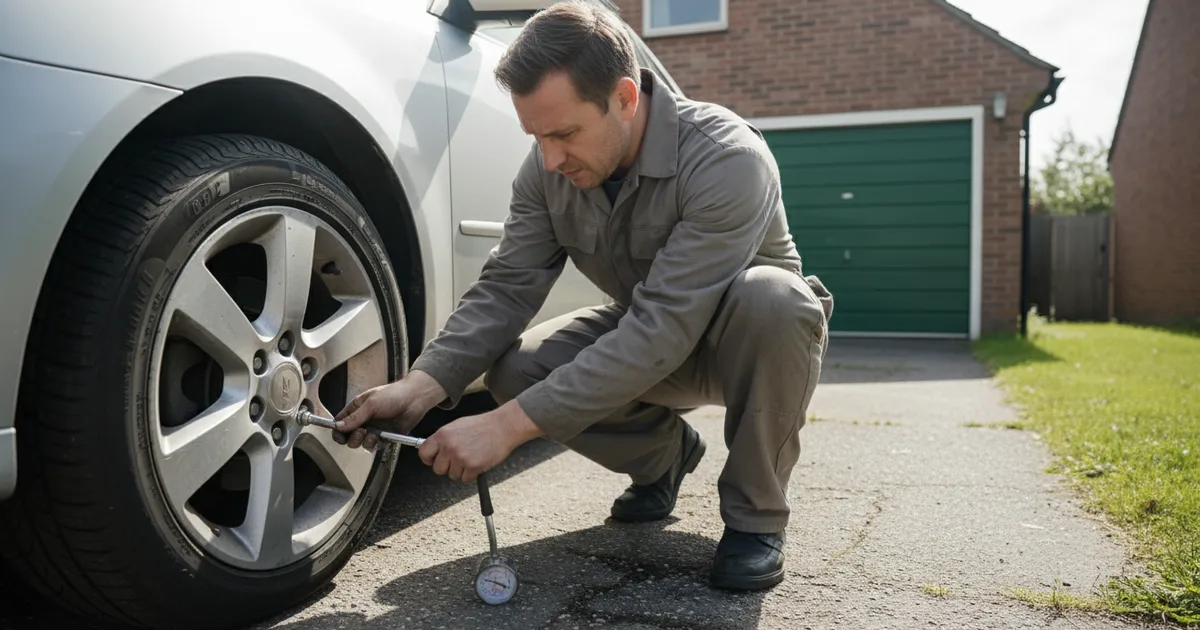
This is really the whole argument for checking tyre pressure regularly rather than just eyeballing the tread. Tread depth tells you about grip and wear. Pressure tells you whether the tyre is structurally doing its job at all. You can have plenty of tread left on a tyre that's still dangerously underinflated, because the two things are measuring different failures. A gauge check takes a couple of minutes and tells you directly whether the air inside is doing what it's supposed to do.
If a tyre has lost enough pressure that it's visibly under the car, or a warning light has come on and you're not near a garage, that's not something to put off. A flat or badly underinflated tyre on the roadside isn't a job to attempt yourself if you're not set up for it, and it isn't a job to leave for tomorrow either, since a collapsed tyre can damage the wheel rim if you keep driving on it. That's the kind of job mobile tyre fitting exists for, coming to wherever the car actually is, whether that's a driveway, a layby or a supermarket car park, rather than asking you to somehow get a car with a collapsed tyre to a garage.
The basic fact is a simple one: air, not rubber, is what's underneath your car. Keeping that air at the right pressure isn't a fussy maintenance extra, it's the thing that keeps the tyre able to do its one job in the first place.