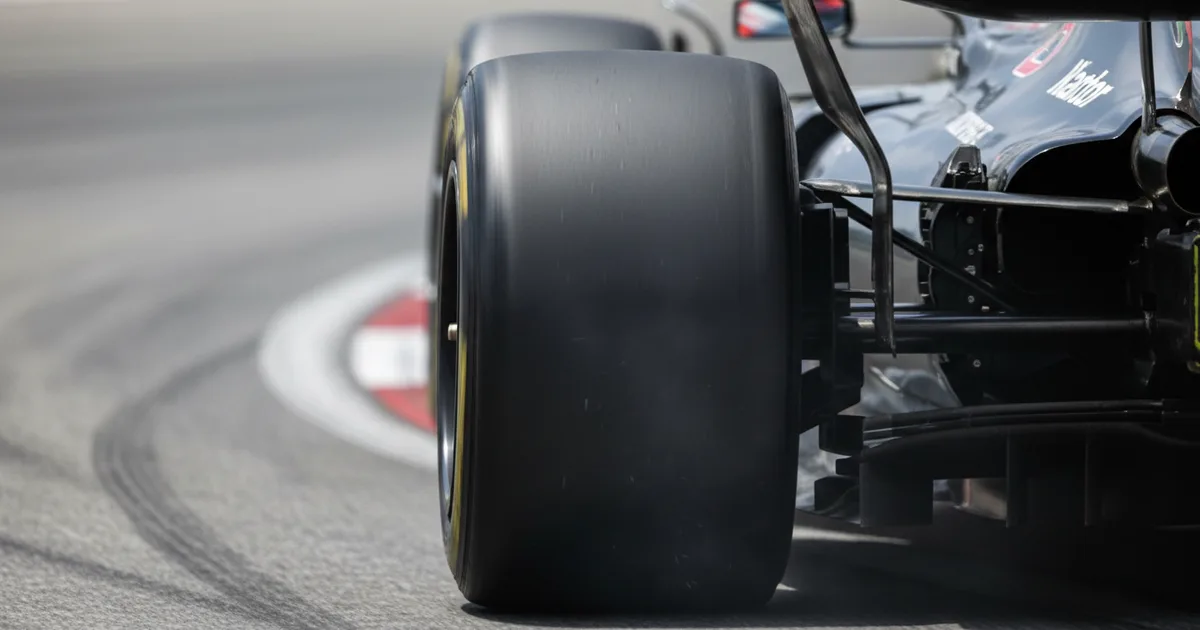
The tyre isn't the weak link, the driver is
Most people assume a race car's limit is set by the tyres. Push too hard, the tyre lets go, the car slides. With a Formula 1 car, that's not actually how the numbers work out. A modern F1 tyre can theoretically produce so much grip that the driver would black out from the G-forces long before the tyre itself ran out of traction. The rubber has more to give than the human body can survive.
That's a strange thing to sit with. We're used to thinking of tyres as the limiting factor in any car, road or track. In F1, the chassis, the aerodynamics and the compound are so far ahead of what a body can withstand that the driver becomes the bottleneck, not the equipment.
What the G-forces actually look like
Modern F1 cars regularly generate 4 to 6 G in cornering and over 5 G under braking. To put that in perspective, fighter pilots train specifically to handle sustained G-loads because untrained bodies start losing blood flow to the brain well before they hit numbers like that. A driver going through Copse at Silverstone or Eau Rouge at Spa is pulling forces that would floor most people, lap after lap, for the best part of two hours.
The car can take more. The tyre can take more. The downforce generated by the wings and floor is pressing that tyre into the tarmac with enough force to let it grip far beyond what feels physically possible. It's the driver's neck, inner ear and cardiovascular system that reach their limit first.
Why this matters for how tyres are built
It tells you something about how differently a race tyre is engineered compared with the one on your car in the driveway. An F1 tyre is a purpose-built component, tuned for a narrow temperature window, a specific track surface and a car producing enormous aerodynamic load. It's asked to do one job, extract maximum grip for a short, controlled life, and it does that job so well it outpaces what a trained athlete's body can take.
A road tyre is built for the opposite brief: consistency across a huge range of temperatures, surfaces and loads, for tens of thousands of miles, with no downforce helping it along. It doesn't need to survive 6 G corners, but it does need to keep gripping in the wet, in the cold, and on a road surface that's seen better days. Different problem, different engineering, but the same underlying physics of contact patch and load are at work in both.
The everyday version of the same physics
You don't need anywhere near F1 loads to notice tyre grip matter on a normal drive. Cornering and braking forces on the roads around Dundee, Perth and across Fife are obviously nowhere close to race car territory, but the same basic relationship between tyre condition, contact patch and available grip still applies. A tyre with tread worn down or pressures off isn't just less efficient, it's giving away grip you might need on a wet roundabout or a frosty back road in Perthshire on a January morning.
The margin most drivers are working with day to day is nothing like the margin an F1 tyre has in reserve. That's exactly why it's worth paying attention to tyre condition rather than assuming there's plenty of grip in hand. There usually isn't as much as people think.
Grip you can't see from the driver's seat
What the F1 example really shows is that grip is easy to take for granted right up until it isn't there. Nobody watching a driver take a corner at 5 G thinks about the tyre compound doing the work, it just looks fast. The same blind spot applies at ordinary road speeds. Drivers don't usually think about tread depth or pressure until something goes wrong on a wet corner or a motorway slip road.
Checking tyres regularly, and getting them replaced before they're marginal rather than after, is the practical version of that F1 lesson. You're not chasing 6 G of cornering force, you're just making sure the grip is there when a wet Tayside road or an icy Fife lane actually asks for it. If a tyre's looking borderline, it's worth sorting sooner rather than later, and if getting to a garage isn't convenient, mobile tyre fitting means it can be done at home or at work instead.
The takeaway from the F1 numbers isn't really about racing at all. It's a reminder that tyre grip is a finite, engineered resource, built for a specific job, and it runs out well before most drivers expect it to. On track, the driver hits their limit first. On the road, it's usually the tyre that runs out of grip first, which is exactly why keeping it in good condition matters more than most people assume.