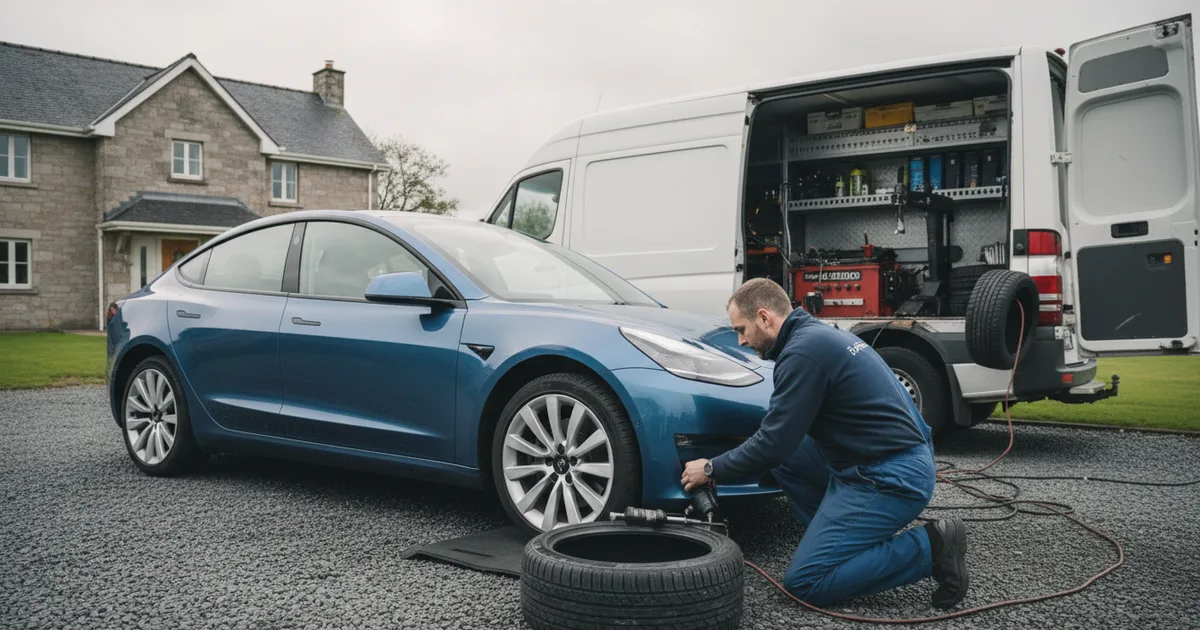
More electric cars are turning up on driveways across Dundee, Perth and Fife every month, and the question we're starting to hear more often is a simple one: can you just fit any tyre to an EV, or does it need something different? The short answer is that an EV places different demands on a tyre than a petrol or diesel car does, and fitting the wrong tyre, or fitting the right tyre badly, shows up faster on an electric car than it would on a conventional one.
Why an EV is harder on tyres
Electric cars carry a heavy battery pack low in the chassis, which usually puts more weight through the tyres than an equivalent petrol model. On top of that, an electric motor delivers its full torque instantly, from a standstill, rather than building power gradually through a rev range. Combine extra weight with instant torque and the result is a tyre that's working harder under acceleration and carrying more load all the time, which tends to wear the tread faster and more unevenly if the tyre wasn't built with that in mind.
Regenerative braking adds another wrinkle. Because the motor itself does a lot of the slowing down, rather than the brakes alone, the front and rear tyres on an EV can wear at different rates than they would on a car that relies purely on friction brakes. It's not a fault with the car, it's just a different pattern of forces going through four contact patches that are still only about the size of a hand each.
What "EV-specific" tyres actually mean
Manufacturers now build tyres with reinforced construction to carry the extra weight, compounds tuned to cope with higher torque without wearing prematurely, and a quieter tread pattern designed to cut road noise. That last point matters more than people expect. There's no engine noise to mask what's happening at the road surface, so any roar or hum from a tyre that isn't built to be quiet is far more noticeable in an EV than it ever was in the car it replaced.
You don't always have to fit a tyre marked specifically for EV use. What matters is matching the load rating and speed rating the vehicle needs, and being honest about the trade-offs if you fit a standard tyre instead. A tyre that isn't rated for the extra weight will wear faster and can run hotter under sustained load, and a tyre that isn't built with noise in mind will simply be louder in a cabin with nothing else to compete with.
Why the fitting itself needs a bit more care
Heavier wheels and tyres change how the whole job is done, not just which tyre goes on. Wheel balancing needs to be spot on, because a car that's already carrying more weight will transmit an out-of-balance vibration more noticeably through the steering and the seat. Torque settings on the wheel bolts matter just as much as on any other car, and getting that right on a heavier wheel and tyre combination is standard practice for us, not an optional extra.
It's also worth knowing that most EVs use tyre pressure monitoring as standard, so a correct reset or relearn after fitting is part of doing the job properly, not something to skip. Get any of these steps wrong and the symptoms show up quickly: a vibration at speed, a dashboard warning that won't clear, or tread that's gone patchy within a few thousand miles.
Where this sits right now
We'll say this plainly: EV tyre fitting isn't yet the volume of work that standard tyre changes are across Tayside and Perthshire, most cars on these roads are still petrol or diesel. But the number of electric cars we're fitting for is climbing steadily, and the physics behind why they need different tyres isn't going away. It's a genuine, growing part of the job rather than a gimmick, and it's worth getting right from the first fitting rather than learning the hard way after a tyre's worn out early.
If you're running an electric car and aren't sure whether your current tyres are the right spec, or you want a fitting done properly with the balancing and pressure system reset handled correctly, our mobile tyre fitting comes to your driveway with the right kit for the job. Electric or not, a tyre that's fitted and balanced correctly the first time is one less thing to think about.