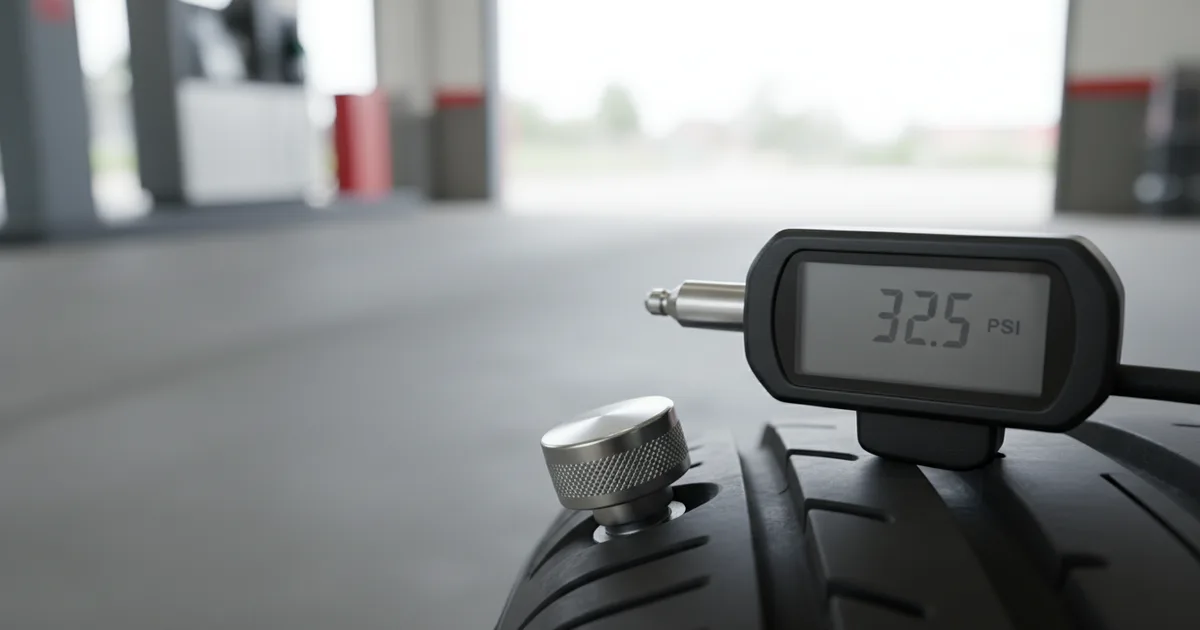
Walk into most tyre bays and you'll see it: a rack of green valve caps, a sign offering a "nitrogen fill" for a few pounds extra, and a pitch that makes it sound like a serious upgrade over ordinary air. Customers ask us about it often enough that it's worth a straight answer. Nitrogen does a couple of real things for your tyres. It just doesn't do as much as the marketing suggests.
What's actually in your tyres right now
Here's the bit dealers rarely mention: the air already in your tyres is roughly 78 percent nitrogen. That's just the composition of the atmosphere. So when someone offers to swap your air for "pure nitrogen," they're not introducing some exotic new gas, they're increasing the nitrogen content from about 78 percent to somewhere in the 90s, having purged out most of the oxygen, water vapour and other bits that come along with normal air. It's a shift in proportion, not a wholesale change in what's filling your tyre.
That framing matters because it resets expectations before you get to the actual differences, which are real but modest.
The genuine differences, and why they're small in practice
Pure nitrogen does leak out of a tyre more slowly than ordinary air. Nitrogen molecules are larger than oxygen molecules, so they migrate through the rubber compound at a slightly reduced rate. Over months, a nitrogen-filled tyre will tend to hold its pressure a touch better than an air-filled one.
Pure nitrogen also carries less moisture. Compressed air from a standard workshop compressor can carry trace water vapour along with it, and that moisture behaves differently to dry gas as temperatures shift. Nitrogen fills are dried and purged specifically to strip that moisture out.
The third difference follows from the first two: because nitrogen holds less moisture and doesn't expand and contract with heat in quite the same way, tyre pressure changes slightly less between a cold morning and a warm afternoon in a nitrogen-filled tyre than in an air-filled one.
All three of these are real, measurable effects. What they are not is dramatic. For normal road use, the difference between air and nitrogen shows up as a slightly slower pressure drop over time and a slightly steadier reading across a temperature swing. It is not the difference between a tyre that's safe and one that isn't, and it is not going to change your fuel economy or grip in any way you'd notice from the driver's seat.
Where the small print gets stretched
The reason nitrogen gets oversold is that the sales pitch conflates "measurable in a lab" with "meaningful on the road." Racing teams and aircraft use nitrogen because they're operating at the extreme edges of pressure and temperature, where a small percentage difference actually matters to performance and safety margins. A daily driver doing the school run and the commute round Dundee, Perth or Fife isn't operating anywhere near those edges. The pressure swings you'll see from a cold Tayside morning to a warmer afternoon are well within what any tyre, air or nitrogen filled, is built to handle.
What actually matters more than which gas is in your tyre is whether the pressure is correct in the first place, and whether you check it. A tyre running 6 or 8 psi low because nobody's looked at it in three months is a bigger factor in wear, handling and fuel use than the type of gas inside it. Nitrogen doesn't remove the need to check pressure, it just slows the rate at which that pressure drifts if you don't.
Our take, for what it's worth
If a garage includes nitrogen inflation as a standard part of a fitting and it costs you nothing extra, there's no harm in it, the slower leak rate and steadier temperature response are genuine, if modest, benefits. If it's being sold as a premium add-on with the implication that your tyres are unsafe without it, that's overstating what the gas does. Air that's correctly maintained at the right pressure will serve you just as well as nitrogen that's neglected.
What we'd rather see is drivers getting their pressures checked properly and regularly, whatever gas is behind the valve. That's a routine part of what we do on every callout, and it's also why we built mobile tyre fitting around coming to you rather than expecting you to find time for a garage visit. A correct check takes minutes. A slow leak you never notice, in air or nitrogen, doesn't fix itself.
So does nitrogen help? Slightly, yes, in the ways described above. Is it the upgrade some forecourts imply it is? No. Keep your pressures checked, and don't let a green valve cap replace that habit.