Every fitter has had the conversation. A customer stares at a shredded sidewall on the hard shoulder and asks why, in this day and age, cars are still running on tyres full of air. It's a fair question. Air pressure is also the reason a nail, a pothole edge or a worn valve can leave you stranded, and it's the single biggest cause of the emergency callouts we do across Dundee, Perth and Fife. So when a tyre that doesn't need air at all gets mentioned in the news, it's worth explaining properly rather than dismissing it as science fiction.
How an airless tyre actually works
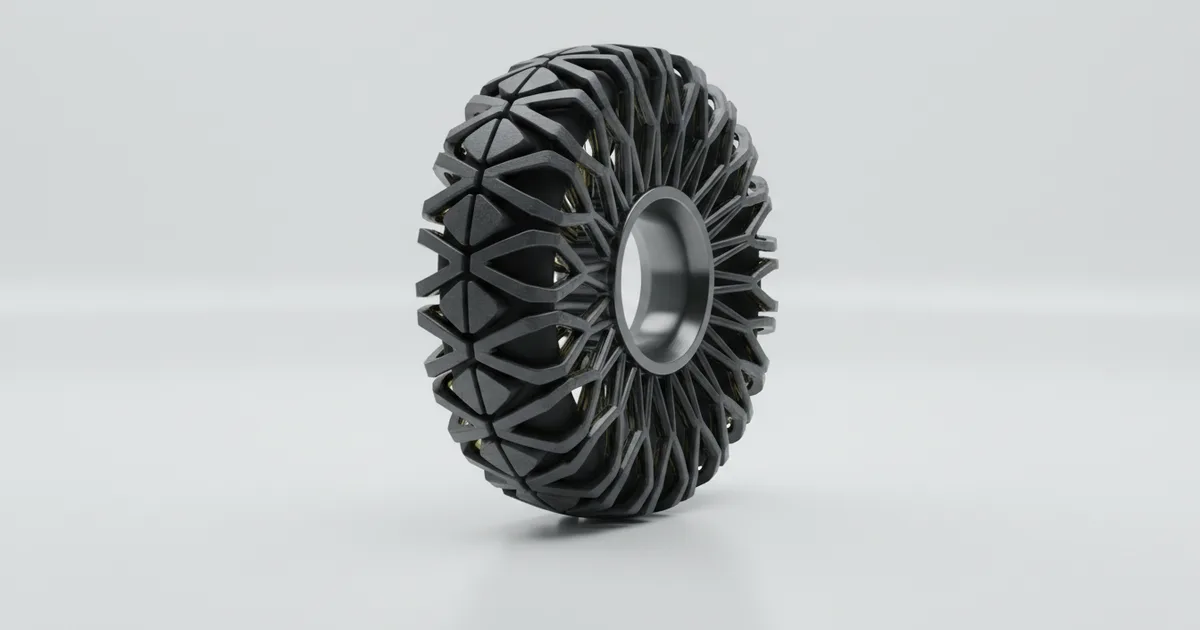
Companies including Michelin have developed airless tyre concepts that replace the compressed air chamber with a web of flexible internal spokes. Instead of air pressure holding the tyre's shape and carrying the vehicle's weight, the spokes themselves flex and support the load. The outer tread still looks much like a normal tyre, but there's no inner tube or sealed cavity to lose pressure from, because there's no pressure to lose.
It's a genuinely different way of solving the same problem tyres have always solved: keep the vehicle in contact with the road while absorbing bumps. Conventional tyres do that with a cushion of air. Airless designs do it with engineered flex in solid material. Both approaches have been around in some form for decades, airless tyres have long been standard on ride-on mowers and some construction plant, but scaling the idea up to a car doing motorway speeds in the rain is a different challenge entirely.
The obvious appeal: no punctures
The headline benefit is straightforward. With no air chamber, there's nothing for a nail, a screw or a sharp pothole edge to puncture. No slow leaks from a corroded valve, no blowouts from a sidewall that's been quietly weakening for months. For anyone who's had a tyre give out on the A90 at half past midnight, that's not a small thing.
There's a consistency angle too. A normal tyre's performance shifts as pressure drifts up or down with temperature and time, which is why we're forever telling customers to check their pressures monthly. An airless tyre, by design, doesn't have that variable. The spoke structure is built to hold its shape regardless of temperature, so in theory the tyre behaves the same on a cold January morning in Perthshire as it does in August. That's the pitch, and it's a credible one given how the technology works.
Why they're not on your car yet
The reason airless tyres aren't already standard fitment has less to do with the concept and more to do with two stubborn practical problems: ride quality and cost. Getting an air-filled tyre's cushioning right is a solved problem, decades of tyre development have tuned exactly how much a tyre should flex, absorb and rebound at different speeds and loads. Replicating that same feel with a solid spoke structure, without it feeling harsh or transmitting every road imperfection into the cabin, is a harder engineering task than it might first appear.
Cost is the other barrier. Manufacturing a precision spoke structure at the volumes needed for everyday passenger cars, and doing it cheaply enough to compete with a conventional tyre, is not yet where it needs to be. Until both of those are cracked, airless tyres are more likely to keep turning up on specialist and off-road vehicles, where the puncture-proof benefit outweighs a stiffer ride and a higher price, before they land on the family hatchback.
What this means for drivers now
None of this changes anything about the tyres sitting under your car this week. Airless tyres for everyday road use are still a development project, not a product you can buy for your Corsa or your work van. The tyres we fit today still rely on correct pressure to perform, resist punctures and wear evenly, which is exactly why a genuine slow puncture or nail is worth sorting immediately rather than topping up the pressure and hoping it holds.
That's where the gap between today's technology and tomorrow's concept actually matters to you. If you do pick up a puncture on the road between Dundee and Perth, or anywhere across Fife, getting it looked at properly and repaired to the right standard beats ignoring a slow leak until it becomes a roadside emergency. Our puncture repair service comes to wherever the car is, so there's no need to limp it home on a tyre that's already lost most of its air.
Airless tyres are a genuinely interesting direction for the industry, and Michelin's work on flexible spoke designs shows there's real engineering behind the idea rather than just a concept render. But ride quality and manufacturing cost are the two things standing between a promising prototype and a tyre you can actually buy for your car. Until that changes, the practical advice stays the same: check your pressures, don't ignore a puncture, and get it fixed properly the first time.